

 Merch
Merch Medical card
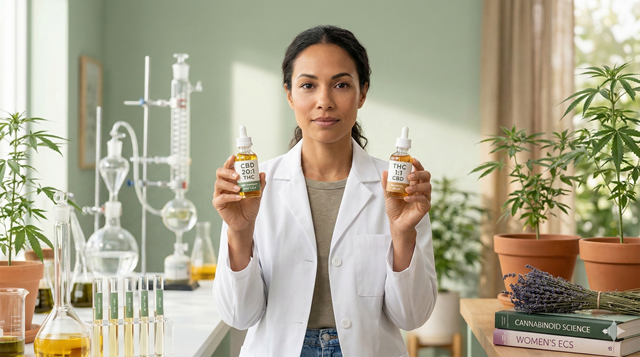
A science-based guide to how different CBD to THC ratios may influence mood, sleep, menstrual comfort, and everyday functioning in women, and where the research is still limited.
Understanding the right CBD to THC ratio for women is increasingly relevant, and increasingly complicated. Walk into almost any dispensary or wellness shop today and you’ll find cannabis products marketed specifically at women’s cannabis wellness, each with its own ratio printed on the label. High-CBD tinctures promising “daily calm.” Balanced 1:1 formulas suggesting relief from discomfort. Yet the science behind which ratios actually work for which concerns, in women specifically, is still catching up to the marketing. Here’s what the current evidence genuinely supports, and where honest gaps remain.


How CBD and THC ratios work differently in women’s bodies
CBD (cannabidiol) and THC (tetrahydrocannabinol) both interact with the body’s endocannabinoid system (ECS), a network of receptors and signaling molecules that help regulate mood, pain perception, sleep, appetite, and immune function. THC binds directly to CB1 receptors in the brain and nervous system, producing the familiar “high.” CBD, by contrast, has a more indirect influence: it modulates CB1 activity, interacts with serotonin receptors, and may dampen some of THC’s psychoactive edge.
That interplay is what makes the CBD to THC ratio matter. A product with far more CBD than THC is likely to produce little to no intoxication, while a THC-dominant formula will produce more psychoactive effects. A roughly balanced 1:1 product sits somewhere in between. A comprehensive review of clinical CBD data found that the specific dose and delivery method, alongside the presence or absence of THC, significantly shapes outcomes across anxiety, pain, and sleep domains.
Why women’s bodies may respond differently
The ECS doesn’t operate in isolation. Estrogen, progesterone, and other reproductive hormones interact with cannabinoid receptors throughout the body, which means hormonal fluctuations across the menstrual cycle may change how sensitive a woman is to both CBD and THC at different times of the month. Research on cannabinoids and the female reproductive system suggests that a THC and estrogen interaction exists at the receptor level, with estrogen potentially upregulating CB1 receptor density and making women more sensitive to THC’s effects during certain cycle phases. This THC estrogen interaction is one reason cannabidiol women’s health researchers consider hormonal context essential for interpreting study results.
It’s also worth noting that most cannabis research to date has used mixed-sex or male-dominant samples. A scoping review focused specifically on cannabinoid use among adult women found that women most commonly report using cannabis products for anxiety, sleep, menstrual discomfort, and general wellness, but that study designs tailored to women remain rare. That’s an important caveat for everything that follows.
CBD to THC ratio patterns and what the research suggests for women
Research so far points to some broad patterns for women’s cannabis wellness, though these come primarily from patient populations with specific conditions rather than from large controlled trials in healthy adult women.
| Ratio profile | General pattern | Evidence level |
|---|---|---|
| CBD-dominant (e.g., 20:1 CBD:THC) | Associated with calm, reduced anxious mood, and improved sleep without intoxication | Moderate |
| Balanced (e.g., 1:1 CBD:THC) | Studied more for pain and quality of life; some intoxicating effect possible | Emerging |
| THC-dominant | Greater psychoactive effect; more cognitive impact; used cautiously for pain | Limited (women) |
A widely cited industry-level summary found that CBD:THC ratio plays a meaningful role in quality-of-life outcomes, with a roughly 1:1 ratio outperforming either cannabinoid alone in certain pain contexts. Meanwhile, a large case series on CBD for anxiety and sleep found that CBD-only doses in the 25–75 mg/day range were associated with improved anxiety scores in 79% of participants within the first month, and improved sleep scores in 67%, though sleep results fluctuated over time.
What this may mean for everyday wellness
Everyday stress and anxious mood
CBD-dominant products, used consistently, appear most relevant here. The case series above and a real-world women’s wellness CBD study involving thousands of participants both found that women using CBD products (some with trace THC) reported meaningful improvements in daily anxiety and general wellbeing. Framing this as “supporting a sense of calm” rather than treating clinical anxiety disorder is appropriate given current evidence.
Sleep quality and winding down
Higher CBD doses appear to have a calming, sometimes sedating effect, making evening use a common pattern in observational research. Adding a small amount of THC may enhance relaxation for some people, though tolerance and next-day grogginess are real considerations with regular THC use.
CBD for menstrual pain and discomfort
This is where some of the most directly relevant women’s data exists. A quasi-experimental study on high-CBD products for menstrual symptoms found that participants using CBD-rich products over several cycles reported meaningful reductions in pain and mood-related symptoms compared with usual care. A separate review of medicinal cannabis for dysmenorrhoea examined a cannabinoid nasal spray in a randomized trial, finding significant pain relief with a formulation containing both CBD and THC. Neither study establishes a definitive ratio recommendation, but both suggest some THC alongside CBD may be more effective for pain than CBD alone.
Midlife transitions and sleep disruption
Perimenopause brings hormonal volatility that can disrupt sleep, mood, and overall comfort. While research in this population is limited, clinical data from a CBD-rich, low-THC oral extract study illustrates how CBD-dominant but THC-containing products behave in practice over time, including quality-of-life improvements. This doesn’t translate directly to perimenopausal wellness, but it suggests that CBD-led combinations may merit further exploration.
A note on evidence quality: Most findings in this area come from small trials, open-label studies, or observational surveys with variable products and dosing. Individual variability is high, and factors like hormonal status, prior cannabis exposure, and product bioavailability all influence outcomes. These patterns are context, not prescriptions.

CBD-only vs. CBD + THC ratio: what the difference means for women
Harvard Health’s overview of CBD captures the general picture well: CBD alone has a reasonable evidence base for anxiety and sleep, while adding THC introduces more complexity, both in terms of potential benefits for pain and in terms of psychoactive effects, tolerance, and other considerations. This distinction roughly mirrors the difference between full-spectrum and broad-spectrum products, where the presence or absence of THC shapes the overall effect profile.
The menstrual pain angle is worth underscoring here. Two of the strongest sources in this space, one examining CBD for dysmenorrhea via a cannabinoid nasal spray and another tracking high-CBD product use over multiple cycles, both suggest that some THC alongside CBD may outperform CBD alone for period pain relief. That doesn’t mean higher-THC products are always appropriate, but it does suggest that broad-spectrum or full-spectrum formulations may be worth considering for women whose primary concern is cycle-related discomfort rather than daily calm.
For women specifically, the reproductive implications of regular THC use deserve mention. Research on cannabinoids and the female reproductive system notes potential interactions with ovarian function at higher or chronic doses. This doesn’t mean short-term, low-THC use is inherently harmful, but it’s a genuine consideration worth discussing with a healthcare provider, especially for anyone trying to conceive.
Where the research still falls short
The honest answer to “what’s the best CBD:THC ratio for women’s wellness?” is that we don’t have enough high-quality, women-specific data to say definitively. What’s missing includes:
- Large, long-term randomized trials comparing specific CBD to THC ratios in healthy adult women
- Studies that account for menstrual cycle phase, contraceptive use, and perimenopause status
- Standardized product formulations that make cross-study comparisons meaningful
- Data on how CBD bioavailability differences between inhalation, oral, and sublingual delivery affect women’s outcomes
That said, the emerging picture is encouraging. Women are the fastest-growing segment of cannabis consumers, and research specifically designed around their experiences is beginning to catch up.
A practical starting point: For women exploring the CBD to THC ratio for everyday wellness, starting with a CBD-dominant product, paying attention to how your body responds at different points in your cycle, and consulting a knowledgeable healthcare provider remains the most grounded approach the current evidence supports.


Sign up for bi-weekly updates, packed full of cannabis education, recipes, and tips. Your inbox will love it.