


 Merch
Merch Medical card
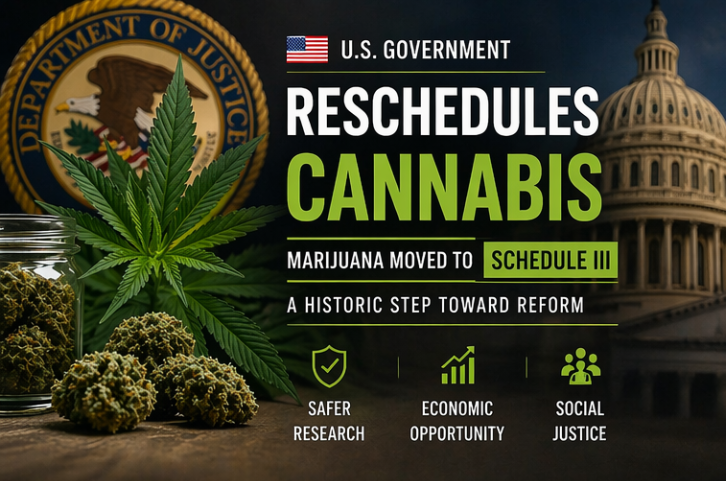
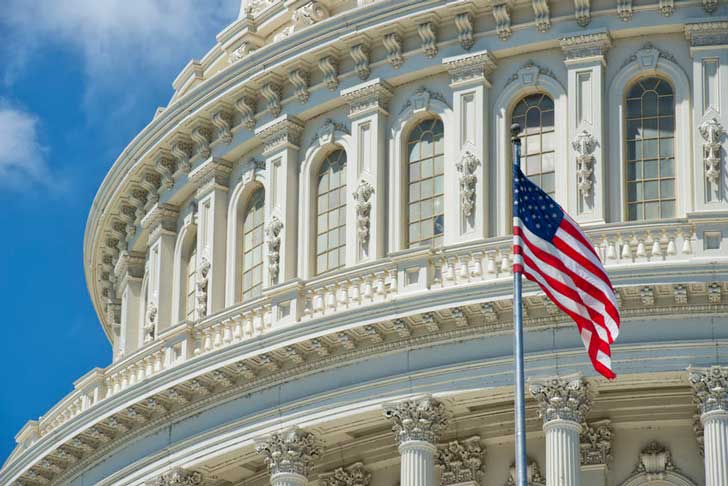
On April 23, 2026, Acting Attorney General Todd Blanche signed an order moving cannabis from Schedule I to Schedule III of the Controlled Substances Act (CSA) — the most significant federal cannabis policy shift in more than fifty years. The action came roughly four months after President Trump’s executive order directing the Department of Justice to expedite the process that had stalled through multiple administrations.
The rollout is deliberately staged. Cannabis products covered by a qualifying state medical cannabis license and any FDA-approved cannabis drugs move to Schedule III immediately. Everything else — including adult-use (recreational) cannabis, hemp-derived intoxicants outside FDA approval, and all unlicensed cannabis — remains on Schedule I. A new expedited administrative hearing process, with deadlines beginning June 29, 2026, will consider broader rescheduling.


Why this matters for science and medicine
For more than fifty years, cannabis sat on Schedule I alongside heroin — a category reserved for drugs with “no currently accepted medical use” and high abuse potential. That classification throttled research. Scientists faced extraordinary hurdles to study a plant that millions of Americans were already consuming medicinally: grants were harder to secure, IRB review took longer, and investigators were often restricted to a single federally approved cultivar of low-potency material that bore little resemblance to real-world products.
Schedule III — the same tier as ketamine, testosterone, and anabolic steroids — removes many of those barriers. DEA registration remains required, but the administrative overhead drops substantially. For the first time, federally funded researchers will be able to obtain state-licensed cannabis products, meaning the products being studied will actually match what patients use. Medical schools can teach cannabis pharmacology without Schedule I red tape. Physicians gain firmer footing to discuss cannabis with patients. Expect a multi-year ramp in clinical trials for chronic pain, PTSD, epilepsy, chemotherapy-induced nausea, and palliative care — indications where observational and anecdotal data have long outpaced controlled evidence.
The tax-code shift matters more than it sounds
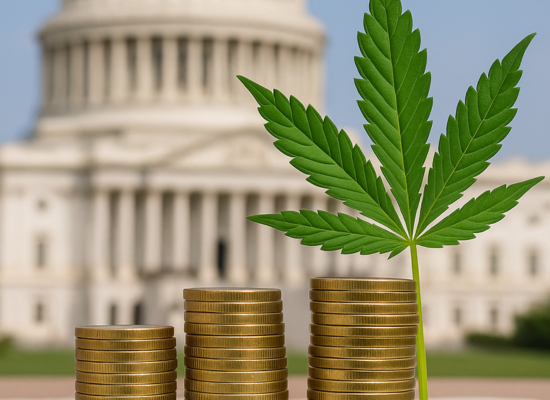
Section 280E of the IRS code — enacted in 1982 to punish cocaine dealers — has prohibited Schedule I and II businesses from deducting ordinary expenses. It has saddled state-legal cannabis operators with effective tax rates of 70% or higher and, by industry estimates, extracted roughly $15 billion in excess tax from the sector since 2018. Removing Schedule III sales from 280E’s reach frees capital that cannabis companies have long been unable to invest in product testing, pediatric formulation research, impurity standards, or post-market surveillance. The DOJ has urged the Treasury to consider retroactive relief for prior tax years — which, if granted, could return significant refunds to medical operators.
Forty states now run medical cannabis programs, collectively serving several million registered patients. In one stroke, those programs have been effectively recognized at the federal level. Only two states — Idaho and Kansas — retain full prohibition.
Limits worth naming
This is not legalization. Adult-use cannabis remains Schedule I and federally illegal. Interstate commerce is still prohibited. Possession penalties haven’t changed. Banking access is not automatically resolved. The FDA continues to define what qualifies as approved medicine, which means most products sold in state dispensaries remain outside the FDA pathway. Industry advocates have been quick to note that rescheduling “stops short of the systemic change” needed, in the words of Marijuana Policy Project executive director Adam J. Smith, and does nothing to end the hundreds of thousands of cannabis possession arrests that still occur annually.
Why the world is watching
The United States has been the architect of modern global drug prohibition since the 1961 UN Single Convention on Narcotic Drugs. It pushed the treaty system into existence, enforced it through the International Narcotics Control Board (INCB), and used it as leverage in bilateral relationships for decades. When the country that wrote the rules loosens them — even partially — the international drug-control edifice shifts.
The INCB has already warned countries like Uruguay and, implicitly, U.S. states that adult-use legalization violates treaty obligations. A U.S. federal acknowledgment that cannabis has “currently accepted medical use” and reduced abuse potential weakens the moral and legal authority of those warnings.
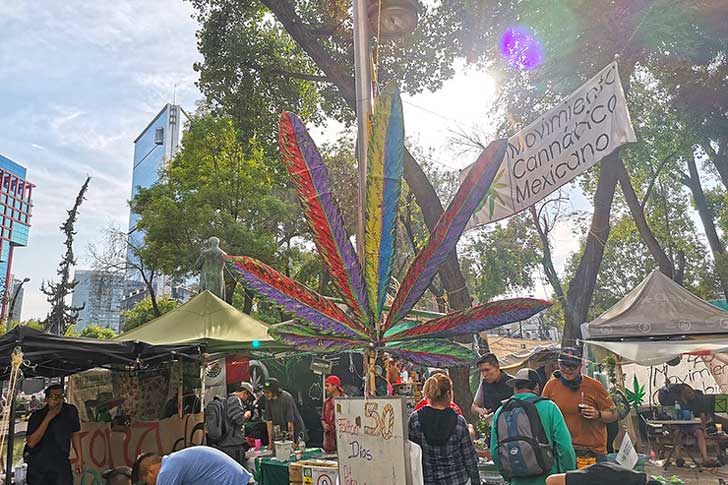
Expect four concrete international effects. In Latin America, Mexico’s stalled legalization push, Colombia’s medical export industry, and Argentina’s medical framework all gain political cover to move further. In Europe, Germany’s 2024 legalization — which already stretched treaty interpretation — is newly vindicated; the Czech Republic’s 2025 reforms and pending debates in France, the Netherlands, and the UK become politically easier. In Asia-Pacific, Thailand’s post-2022 rollback may slow, while Japan’s 2023 medical reforms and Australia’s expanding medical program gain a clearer international path. And globally, pharmaceutical companies can now pursue cannabis-based drug development with reduced regulatory friction, opening cross-border research collaborations that were impractical under Schedule I.
Pressure will now grow on the WHO and the UN Commission on Narcotic Drugs to revisit cannabis’s international scheduling. The 2020 removal from Schedule IV of the Single Convention was a crack in the wall. April 23, 2026, is a much larger one.
This is not the finish line. It is the most consequential federal shift in U.S. cannabis policy in more than half a century — and the first in which the U.S., rather than dragging the rest of the world toward prohibition, has quietly moved in the other direction.
Sources
- DOJ: Justice Department Places FDA-Approved Marijuana Products in Schedule III
- CNN: Justice Department reclassifies state-licensed medical marijuana
- Marijuana Moment: Federal Marijuana Rescheduling Announced By DOJ
- CBS News: Justice Department eases restrictions on some marijuana products
- CNBC: Trump administration moves to reclassify cannabis
- Cannabis Business Times: Industry Stakeholders React to Schedule III Order
- High Times: Don’t Call It Legalization
- Axios: Trump changes marijuana rules, easing federal research limits
- UN News: UN commission reclassifies cannabis
- EUDA: Cannabis laws in Europe — international obligations


Sign up for bi-weekly updates, packed full of cannabis education, recipes, and tips. Your inbox will love it.