

 Merch
Merch Medical card
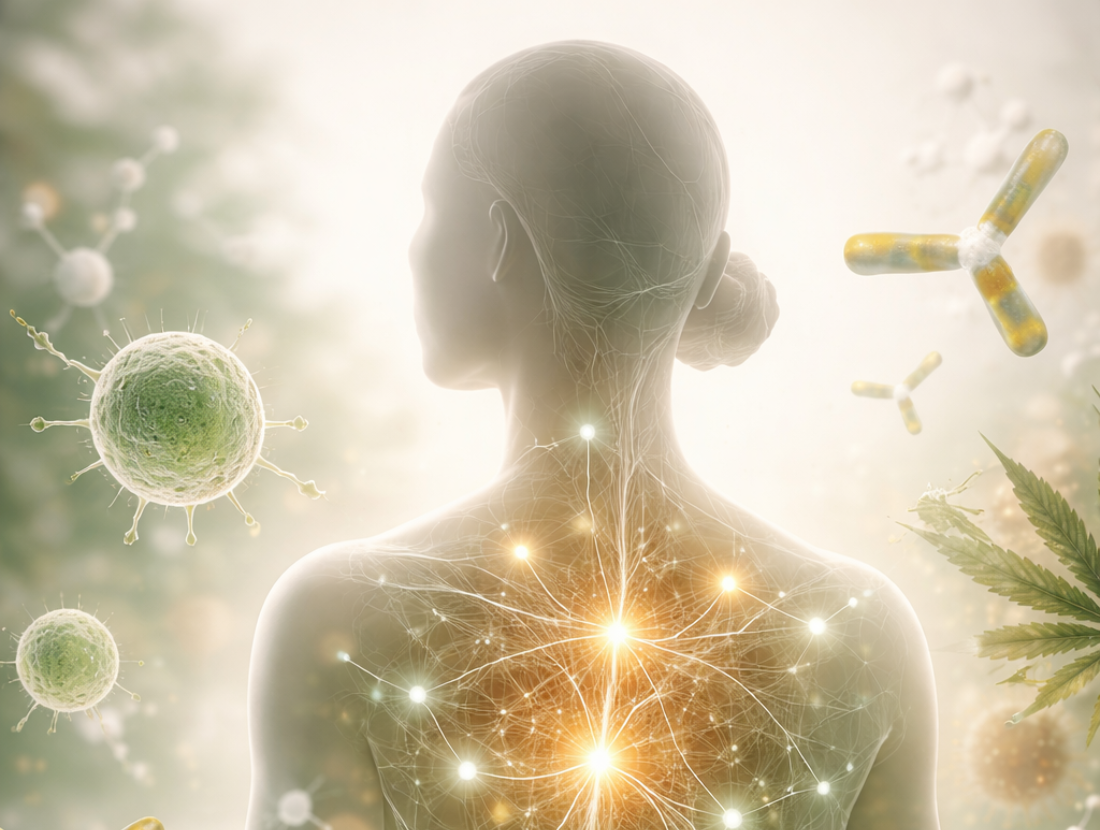
An evidence-based look at how cannabinoids regulate immune function—sometimes calming inflammation, sometimes enhancing defense.
You’ve probably seen cannabis products marketed as “immune support.” But what’s actually happening when cannabinoids interact with your immune system? The answer turns out to be more interesting than simple immune boosting: cannabinoids appear to be bidirectional immune modulators. That means they can dial immune responses up or down depending on the context.

This nuance matters quite a bit. In conditions where your immune system attacks your own tissues—like rheumatoid arthritis or inflammatory bowel disease—cannabinoids may help calm the overreaction. But when you’re fighting a viral infection, some research suggests they might actually enhance certain defensive mechanisms. Let’s break down what we know.
The CB2 Receptor: Your Immune System’s Cannabis Connection
Unlike CB1 receptors, which are concentrated in your brain, CB2 receptors sit throughout your immune system—on T cells, macrophages, neutrophils, and dendritic cells. When cannabinoids activate these receptors, what happens next depends on which cell type is involved and what state it’s already in.
Here’s what researchers have found: CB2 activation can promote regulatory T cells (Tregs), which act as peacekeepers that prevent your immune system from overreacting. At the same time, it may suppress the cells that drive inflammatory conditions. A 2021 study showed that cannabinoids can induce functional Tregs—essentially training your immune system toward balance rather than aggression.
Calming the Cytokine Storm
One of the most promising research areas involves severe inflammatory responses. When your immune system overreacts—as can happen in sepsis or severe COVID-19—it triggers a “cytokine storm” that damages tissues throughout your body. This is where cannabinoids get particularly interesting.
A 2022 study revealed that THC and CBD together inhibit key molecular switches that drive inflammatory cascades. By interrupting these pathways, cannabinoids may help prevent runaway inflammation before it causes serious damage.
Even more recent research from 2025 examined high-CBD extracts in rheumatoid arthritis models. The findings showed that CBD helped switch immune cells from “attack mode” to “cleanup and repair mode”—reducing destructive inflammation while promoting tissue healing.
The Antiviral Side of the Story
Here’s where things get really interesting: while cannabinoids suppress certain inflammatory pathways, they may actually enhance others involved in fighting infections. A 2022 study in Science Advances found that CBD inhibited SARS-CoV-2 replication by boosting interferon responses—your body’s early warning system against viral invaders.
Research on psoriasis patients’ immune cells showed something similar: CBD shifted the response away from autoimmune inflammation while simultaneously boosting natural killer cell activity. This selective effect—calming autoimmune responses while preserving antiviral defenses—suggests cannabinoids aren’t simply immunosuppressive. They’re doing something more nuanced.
Your Gut: Where Cannabinoids Meet Your Microbiome
The endocannabinoid system plays a crucial role in gut immune balance, and this relationship extends to plant-derived cannabinoids too.
Cannabinoids appear to influence your gut microbiome in ways that affect immune function throughout your body. Research shows they can increase beneficial bacteria like Lactobacillus and Akkermansia while reducing pro-inflammatory species. These microbial changes lead to increased production of metabolites that strengthen your gut barrier and promote regulatory T cell expansion.
Since roughly 70% of your immune cells reside in gut-associated tissue, these local effects can translate to system-wide immune modulation. It’s a reminder that what happens in your gut doesn’t stay in your gut.


What You Should Know Before Trying This
Before you start thinking of cannabinoids as a cure-all for immune issues, some important cautions apply:
- Dose matters—a lot: Cannabinoid effects on immune cells can be biphasic. Low concentrations may stimulate while high concentrations suppress. Finding the right dose for any therapeutic effect remains challenging.
- Cancer immunotherapy concerns: Multiple 2024–2025 studies have found worse outcomes when cannabis is used alongside immune checkpoint inhibitors. If you’re undergoing cancer treatment, talk to your oncologist about cannabis use.
- Bioavailability challenges: Oral cannabinoids have poor absorption (around 6–19%), which complicates dosing for therapeutic purposes.
- Healthy people may not benefit: A 2024 randomized controlled trial found daily CBD beverages didn’t improve health markers in healthy individuals. The benefits appear more relevant if you’re dealing with an inflammatory or autoimmune condition.
Try this: If you’re exploring cannabinoids for immune-related conditions, start with low doses and track your response over several weeks. Work with a healthcare provider who understands both your condition and cannabinoid pharmacology.
The Bottom Line
Cannabinoids interact with your immune system in sophisticated, context-dependent ways. The therapeutic potential in autoimmune and inflammatory conditions is real and increasingly well-documented. But calling them “immune boosters” misses the point entirely—they’re better understood as modulators that help restore balance.
For people living with autoimmune conditions, these findings offer genuine hope. For everyone else, the science suggests cannabinoids aren’t magic immune enhancers, but rather compounds that work with your body’s own regulatory systems in ways we’re only beginning to understand.
References
- Cannabidiol as an immune modulator: A comprehensive review. PMC.
- High CBD extract modulates inflammation and immune cell activity in rheumatoid arthritis. Frontiers in Immunology. 2025.
- Cannabinoids alleviate LPS-induced cytokine storm via NLRP3 inflammasome and STAT3 signaling. PMC. 2022.
- Cannabidiol inhibits SARS-CoV-2 replication through induction of interferon. Science Advances. 2022.
- Role of gut microbiota in cannabinoid-mediated suppression of inflammation. PMC. 2023.
- Cannabinoids induce functional Tregs by promoting tolerogenic dendritic cells. Nature Mucosal Immunology. 2021.
- Therapeutic prospects of cannabinoids in the immunomodulation of autoimmune diseases. PMC. 2021.
- Cannabidiol exerts multitarget immunomodulatory effects on PBMCs from psoriatic patients. Frontiers in Immunology. 2024.
- Endocannabinoid system acts as a regulator of immune homeostasis in the gut. PNAS. 2017.
- The CB2 receptor and its role as a regulator of inflammation. PMC. 2016.


Sign up for bi-weekly updates, packed full of cannabis education, recipes, and tips. Your inbox will love it.