


 Merch
Merch Medical card
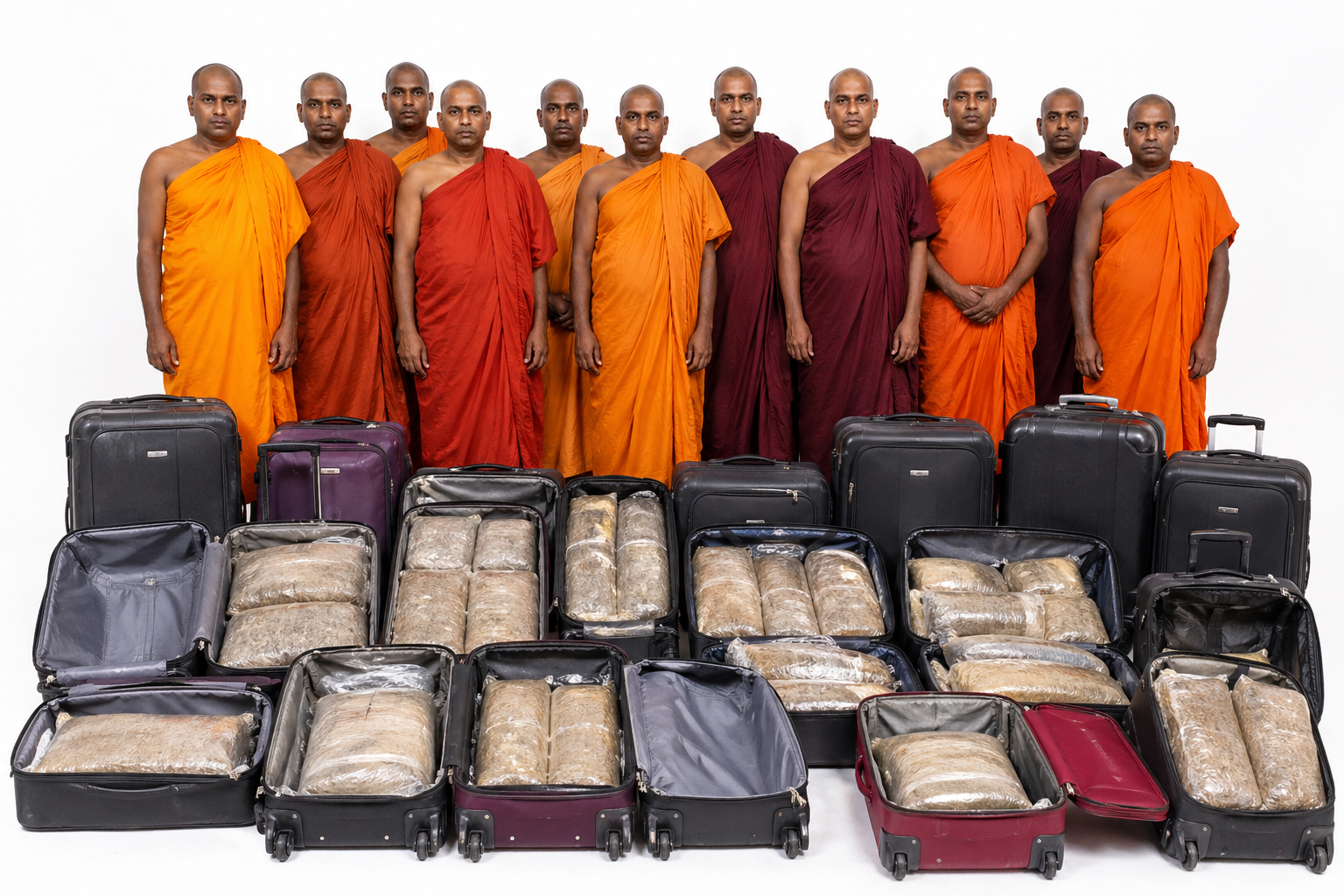
On April 27, 2026, Sri Lankan authorities announced the largest drug seizure ever recorded at Colombo’s Bandaranaike International Airport: 22 Buddhist monks arrested with approximately 110 kilograms (around 242 pounds) of cannabis hidden in false compartments inside their luggage. The street value was estimated at about 1.1 billion Sri Lankan rupees, or roughly $3.4 million USD. A senior monk waiting at the airport to receive the group was arrested separately the following day in a Colombo suburb. Investigators said a WhatsApp group coordinated by the senior monk was used to organize the operation.
The story has drawn international attention not just because of the scale of the seizure, but because of who was arrested. Buddhist monks occupy a position of extraordinary religious and social authority in Sri Lanka. The arrests are the first of their kind at the country’s main international airport.


What happened
The 22 monks — described by Sri Lankan police as young men recruited from various parts of the country — flew to Thailand on April 22, 2026. According to police statements, their travel was financed by a sponsor whose identity is part of the ongoing investigation. Each monk returned with roughly five kilograms (about 11 pounds) of cannabis concealed inside specially modified suitcases. The drugs, which authorities have identified as ‘Kush’ and hashish, were packed alongside school supplies and confectionery — an apparent attempt to mask the contents at customs.
Sri Lanka’s Police Narcotics Bureau has stated that it is investigating whether the operation is connected to existing local drug-running networks. Police also noted, importantly, that some of the arrested monks may not have known what they were carrying — a detail that will likely matter at trial.
Why Thailand to Sri Lanka?
The geographic route is not coincidental. Thailand decriminalized cannabis in 2022, opening one of the most permissive cannabis markets in Asia. By June 2025, Thailand had begun rolling those policies back, restricting recreational sales and tightening rules around medical use. By February 2026, more than 7,000 of the country’s roughly 18,400 cannabis shops had shut down. The result is a transitional market in which cannabis remains more readily available — and significantly cheaper — than in nearly any other country in the region.
Sri Lanka, by contrast, maintains some of Asia’s strictest cannabis laws. Trafficking offenses can carry life imprisonment and, in extreme cases, the death penalty (though Sri Lanka has not executed anyone for drug offenses in decades). The price differential between the two markets creates a powerful economic incentive for trafficking, even across short distances.
What is ‘Kush’ in this context?
‘Kush’ is a slang term that, in many parts of Asia and Africa, refers broadly to high-potency cannabis flower or to hashish — concentrated cannabis resin pressed into bricks. It is not a single strain or product. The cannabis seized in this case is reported to be both high-potency flower and hashish, packaged for retail-scale distribution rather than personal use.
The wider picture
Asia’s cannabis policy is a patchwork. Thailand has been alone among major regional economies in legalizing recreational use, and even that experiment is now being walked back. Most other countries — including Sri Lanka, India (with religious-use exceptions), Indonesia, Malaysia, the Philippines, and Singapore — maintain strict prohibition with severe criminal penalties. The result is consistent: large price gaps across borders, the emergence of trafficking routes that exploit those gaps, and prosecutions that capture surprising people in surprising roles.
The Sri Lanka case is also a reminder that the social authority of any institution — religious, educational, civic — does not insulate it from criminal exploitation. Senior figures who command that authority can use it to recruit and direct younger members. The Cannigma’s editorial position has long held that science-based regulation, transparent supply chains, and educated consumers are how democracies prevent these dynamics from emerging in the first place. Where prohibition is the policy, criminal markets fill the gap, and the people pulled into those markets often look very different from the cartoon trafficker of public imagination.
The investigation continues. Court detention of the senior monk has been ordered, and prosecutorial decisions about the 22 younger monks are pending.
Sources
- Thailand recriminalization, Cannabis Science & Tech
- CNN
- CBS News
- Greek Reporter
- High Times
- Spokesman-Review


Sign up for bi-weekly updates, packed full of cannabis education, recipes, and tips. Your inbox will love it.