
 Merch
Merch Medical card
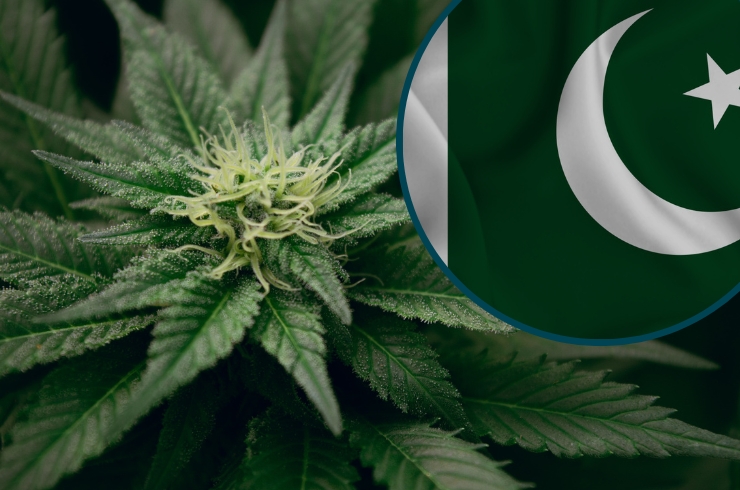
No, weed is not legal in Pakistan. Cannabis is controlled under the Control of Narcotic Substances Act 1997, and there is no personal-use threshold, so possessing any quantity is an offence. The detail that matters most is that Pakistani law punishes charas and hashish far more severely than herbal cannabis at the same weight, despite both falling under one statutory definition.
This guide explains Pakistan’s cannabis laws, how hash is treated differently, where bhang stands, and what the hemp reforms actually amount to.

Is weed legal in Pakistan for recreational use?
Recreational weed is illegal in Pakistan. The governing statute is the Control of Narcotic Substances Act 1997, which applies nationwide and prohibits cultivation, possession, production, sale, distribution, transport, import and export.
The Act was substantially amended in 2022, when its penalty section was replaced with substance-specific tables, and again in 2023, when capital punishment was removed from it.
There is no legal market and no tolerated amount. Pakistan is often described as a cannabis-producing country, which overstates it: the more accurate description is that Pakistan has a long cultural association with charas and functions as a major transit route for hashish produced in Afghanistan.
Is hash or charas legal in Pakistan?
No, and this is where Pakistani cannabis law becomes genuinely distinctive. Charas and hashish are illegal, and they are punished far more harshly than herbal cannabis.
The Act uses a single umbrella definition. “Cannabis (hemp)” covers cannabis resin, which is charas, along with hashish oil, the flowering and fruiting tops, and mixtures, and it expressly states that it includes all forms known as bhang, siddhi or ganja. There is no separate statutory definition of charas sitting outside that.
But the penalty tables split them. Resin, herbal material and oil each get their own sentencing track, and the resin track is dramatically steeper. At the same weight, a charas charge can carry many times the exposure of a bhang charge. That gap is the single most important practical fact for anyone reading about cannabis in Pakistan, because charas is what is actually circulating.
Is bhang legal in Pakistan?
No. Bhang is named inside the statutory definition of cannabis and given its own band in the penalty tables, so it is squarely illegal.
This is worth stating plainly because the comparison with India misleads people. India’s narcotics law excludes bhang, the leaves and seeds, from its definition of cannabis. Pakistan’s law does the opposite and names it in. Bhang has a degree of social visibility in some regional and shrine contexts, but social tolerance is not a legal defence and does not change what the statute says.
What are the penalties under Pakistan weed laws?
Penalties under Pakistan weed laws are set by weight and by substance, not by what you were doing with it. This is the structural point that surprises people most.
Simple possession, transport and organised trafficking all feed into the same penalty table. The Act does not grade by conduct type, so holding a quantity and trafficking the same quantity attract the same band. There is no personal-use carve-out, and even the lowest charas band carries a mandatory minimum sentence.
The tables escalate steeply. For charas, the lowest band carries a maximum of several years with a minimum measured in months, and the highest band reaches life imprisonment with a minimum of twenty years. Cultivation is a separate offence carrying up to seven years, with an express exception for cultivation licensed for medical, scientific or industrial purposes.
On the death penalty, precision matters and a lot of published guidance gets it wrong. Cannabis offences have never carried the death penalty under the current sentencing tables, where capital punishment appeared only in the top bands for heroin, morphine and cocaine.
Those remaining references were then removed altogether by the 2023 amendment. The most severe sentence available for a cannabis offence in Pakistan is life imprisonment.
Penalties at a glance
| Substance and conduct | Basis | General position |
|---|---|---|
| Charas or hashish, any handling | CNSA 1997, s.9 as amended 2022 | Graded by weight, with mandatory minimums; the top band reaches life imprisonment |
| Bhang or herbal cannabis, any handling | CNSA 1997, s.9 as amended 2022 | Graded by weight, at substantially lower bands than resin |
| Hashish oil | CNSA 1997, s.9 as amended 2022 | A separate category with its own bands |
| Cultivation | CNSA 1997, s.4 | Up to 7 years, with a licensing exception for medical, scientific or industrial use |
| Any cannabis offence | CNSA 1997 as amended 2023 | No death penalty available |
Is medical marijuana legal in Pakistan?
There is a legal pathway in principle and no patient access in practice.
The Act has always allowed licensed cultivation for medical, scientific or industrial purposes, and a regulatory structure has been built on top of that.
The federal cabinet approved industrial and medical hemp in 2020, a Cannabis Control and Regulatory Authority was created by ordinance in 2024 and then by Act later that year, and the cabinet approved a national cannabis control and regulatory policy in January 2026.
What has not happened is implementation. As of mid-2026 the authority was still being stood up, with supplementary funding going on refurbishing its headquarters, and there was no reporting of licences issued or a functioning licensing regime. No cannabis medicine appears to be registered and no prescribing framework has been published.
So the accurate description is approved and being built, not legal and not available.
Is CBD legal in Pakistan?
CBD is not lawfully available at retail in Pakistan. No CBD product appears to be registered with the drug regulator, and cannabis-derived CBD engages the narcotics law directly.
The Cannabis Control and Regulatory Authority framework does contemplate cannabis derivatives for medical and industrial use, and a THC ceiling has been reported in connection with it, though that figure comes from press reporting rather than from a statute that could be checked. Until the authority is actually licensing, none of it creates a legal consumer market.
Can you smoke weed in Pakistan as a tourist?
No, and the gap between visible availability and legal exposure is wider in Pakistan than almost anywhere else in this series. Charas is present and socially visible in parts of the country, and none of that provides any protection.
The UK Foreign, Commonwealth and Development Office states in its Pakistan travel advice that you can get a prison sentence for possession of even small quantities, and that British nationals arrested on drug trafficking charges have been detained for long periods while their case moves through the system.
That last point is the real risk. Domestic human-rights reporting indicates that the overwhelming majority of prisoners held under the narcotics Act are awaiting trial rather than convicted, and bail is restricted for these offences. The practical consequence of an arrest is likely to be a long period in custody before anything is decided.
The bottom line on cannabis in Pakistan
Weed is illegal in Pakistan with no personal-use threshold, and penalties are set by weight rather than by what you intended to do. Charas and hashish sit on a far harsher sentencing track than herbal cannabis, bhang is expressly illegal despite its cultural visibility, and the maximum for any cannabis offence is life imprisonment rather than death.
A medical and industrial hemp framework has been approved and a regulator created, but nothing is operational yet. For a visitor, the combination of mandatory minimums, restricted bail and very long pre-trial detention makes this a particularly bad place to take a chance.
Last reviewed: September 28, 2026. Cannabis laws change frequently, always verify current rules with official sources before you travel.


Sign up for bi-weekly updates, packed full of cannabis education, recipes, and tips. Your inbox will love it.