

 Merch
Merch Medical card
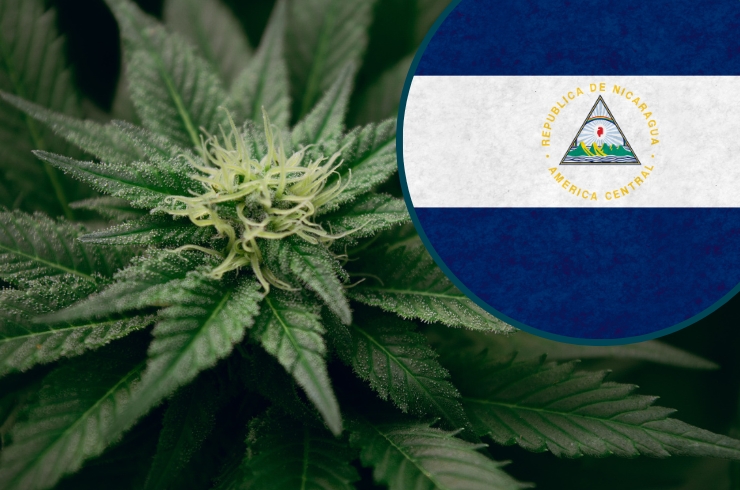
Quick answer: no. Cannabis is illegal in Nicaragua for every purpose, there is no medical programme, and there is no personal-use allowance.
Possession of more than 5 grams carries 6 months to 3 years in prison under Article 358 of the Penal Code. Above 20 grams that becomes 3 to 8 years. The commonly repeated claim that Nicaragua permits 5 grams for personal use is a citation to a law that was repealed in 2008.


Which law actually applies
Two corrections are needed before the penalties make sense, because both errors are common in English-language coverage.
Cannabis is criminalised by Ley No. 641, the Penal Code, adopted on 13 November 2007 and in force from 4 July 2008. Ley No. 735 of 2010, the organised crime law, is frequently cited as the governing statute but it creates no drug offences at all. It is a procedural and asset-forfeiture instrument that defines organised crime by cross-reference back to Ley 641.
Ley No. 285 of 1999, the older narcotics statute, is only partly alive. Article 566 of the Penal Code expressly repealed its entire penal chapter, Articles 50 to 72. Its administrative and licensing provisions survive, and that distinction matters for the medical question further down.
The most recent change is Ley No. 1216, approved on 4 September 2024 and published in La Gaceta No. 166 on 6 September 2024, which reformed a long list of Penal Code articles including Article 358 itself.
Penalties for cannabis possession in Nicaragua
Article 358 sets two tiers, and it is drafted around both plant counts and weights.
The lower tier covers one to five plants containing psychoactive substances, or more than 5 grams and less than 20 grams of marijuana. It carries 6 months to 3 years in prison and 50 to 100 días multa.
The upper tier applies where the quantity exceeds five plants or 20 grams of marijuana. It carries 3 to 8 years in prison and 100 to 300 días multa.
Note that fines are expressed in días multa, a day-fine unit calculated against the defendant’s circumstances, not as a fixed córdoba amount. Any article quoting you a flat córdoba figure for a cannabis fine is not reading the statute.
Note too that small-scale cultivation of up to five plants is charged as possession under Article 358 rather than under the separate cultivation offence.
Penalties at a glance
| Quantity | Prison | Fine | Provision |
|---|---|---|---|
| More than 5 g and less than 20 g of marijuana, or 1 to 5 plants | 6 months to 3 years | 50 to 100 días multa | Penal Code, Art. 358 |
| More than 20 g of marijuana, or more than 5 plants | 3 to 8 years | 100 to 300 días multa | Penal Code, Art. 358 |
| 5 g or less | Falls below the Article 358 threshold; reportedly handled as a falta carrying a fine and community service | Reported as 70 to 100 días multa plus 30 to 60 days’ community service | Reported as Penal Code, Art. 561 |
Trafficking, transport, processing, financing and larger-scale cultivation are separate offences in the narcotics chapter of the Penal Code, running from Article 348 to Article 359, and they carry substantially longer terms than possession. Specific figures for those articles are not stated here because they could not be confirmed against the statute text.
One procedural point from the 2024 reform: Article 565 as amended provides that drug offences are tried by a technical judge rather than a jury.

The “5 grams for personal use” claim is out of date
This is the single most repeated error about Nicaragua, and it has a real origin, which is why it persists.
The figure comes from Article 67 of Ley 285, passed in 1999. That provision set out a genuine personal-consumption regime: a person caught with no more than 5 grams of marijuana faced arrest of up to 30 days plus a fine on a first offence, with higher penalties on reoffending and a referral to rehabilitation where the person was found to be addicted.
Article 67 sits squarely inside the block of Articles 50 to 72 that the Penal Code repealed. There is no longer any statutory personal-consumption regime in that form.
What exists instead is narrower and weaker. Article 358 has a numerical floor: it bites only at quantities above 5 grams. Possession of 5 grams or less is therefore not described by the felony article. That is a gap in the drafting, not an exemption, an allowance or a right.
Two independent secondary sources state that sub-5 gram possession is caught instead by Article 561 as a falta, punishable by 70 to 100 días multa plus 30 to 60 days of community service.
That could not be verified against the statute, so it is reported here rather than asserted. Either way, the honest summary is that Nicaragua has no personal-use exemption, and the FCDO’s own warning is that possession of even small quantities can lead to imprisonment.
Do not call any of this decriminalisation.
Is there medical cannabis or legal CBD in Nicaragua?
No medical cannabis law exists and no bill has been introduced.
There is a theoretical route. Article 38 of Ley 285, which survives the repeal, prohibits all activity related to the sowing, cultivation and production of Cannabis sativa throughout the national territory except with the express authorisation of the Ministry of Health, and Articles 3 and 19 give the ministry licensing power for medical, toxicological and research purposes.
No evidence could be found that the ministry has ever issued such an authorisation for cannabis, and no register or resolution is published.
CBD has no separate legal status in Nicaragua. There is no CBD statute, no THC-limit carve-out and no hemp legislation. Article 38 names the species Cannabis sativa with no THC threshold attached, which on its face captures industrial hemp as well.
The reasonable reading is therefore that CBD products are not distinguished from cannabis and are not affirmatively legal, but this is an inference from the absence of a rule rather than a published prohibition naming CBD.
The gap between the law and what happens
This is the section that matters more in Nicaragua than in most countries, and leaving it out would make the penalties table misleading.
Nicaragua’s judiciary is not independent, and the Penal Code has been used against political opponents. Independent Nicaraguan press reported the 2024 Ley 1216 reforms as extending transnational prosecution and enabling mass confiscation. The sentencing tariffs above describe the law on paper; they are not a reliable prediction of what happens to a particular defendant.
The US State Department’s travel advisory is unusually direct about this. It tells travellers to reconsider travel to Nicaragua due to arbitrary enforcement of laws, the risk of wrongful detention and limited healthcare.
It states that the Department has determined there is a risk of wrongful detention of US nationals by the Government of Nicaragua, that US citizens arrested in Nicaragua may be detained for long periods without charges, and that those arrested can be denied fair and transparent treatment. You can read the current Nicaragua travel advisory in full.
For a foreign national caught with cannabis, in other words, the practical risk is not primarily the sentencing range. It is indefinite pre-charge detention and the limits of consular protection.
Enforcement context
Nicaragua sits on the Central American cocaine transit corridor, and cannabis enforcement is embedded in a much larger counter-narcotics posture aimed at transiting cocaine.
The United States formally designates Nicaragua a major drug transit or major illicit drug producing country under the annual Presidential Determination. Worth noting for balance: Nicaragua was not among the countries determined to have failed demonstrably to meet its counter-narcotics obligations, a category that in the same determination covered only Bolivia, Burma and Venezuela.
Reliable country-level seizure figures are hard to come by. Nicaraguan National Police statistics have been widely questioned since 2018, and the government has stopped cooperating with several international reporting mechanisms, so no seizure tonnage is quoted here.
What visitors should know
The UK Foreign, Commonwealth and Development Office puts it in one line in its Nicaragua travel advice, updated in December 2025: do not become involved with drugs of any kind, and possession of even small quantities can lead to imprisonment.
There is no legal supply anywhere in the country, no tolerated amount, and nothing in the law that treats a tourist more leniently than a resident. Given the detention risk described above, the gap between a minor offence and a serious personal problem is narrower in Nicaragua than the statute alone suggests.
Last reviewed: September 17, 2026.


Sign up for bi-weekly updates, packed full of cannabis education, recipes, and tips. Your inbox will love it.