
 Merch
Merch Medical card
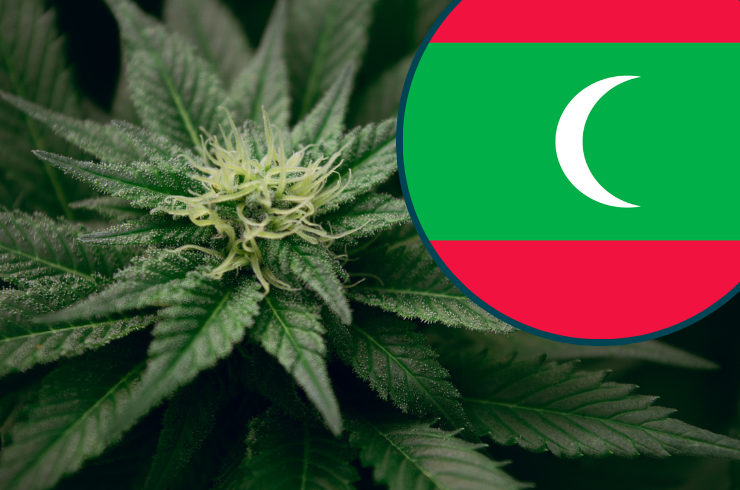
Quick answer: no, and the law got significantly harsher in 2026. Cannabis is a Schedule 1 drug under the Drugs Act, using it carries up to 3 years, and trafficking carries life imprisonment.
A Third Amendment in force since March 2026 added the death penalty for importing more than 350 grams of cannabis into the country. The resort-island exception that applies to alcohol has no equivalent for drugs.

The law changed in March 2026
If you are reading older guidance on the Maldives, it is out of date on the most serious point.
The governing statute is the Drugs Act, Law No. 17/2011, amended by Law No. 31/2015 and Law No. 37/2015. A Third Amendment was ratified on 6 December 2025 and came into force on 7 March 2026, and it did four significant things.
It raised the penalty for trafficking a Schedule 1 drug by import or export to 20 years’ imprisonment with a fine of MVR 75,000 to MVR 7,500,000. It introduced the death penalty where the cannabis threshold is exceeded at the point of entry.
It hardened what “life imprisonment” means, so that a life sentence is now served without reduction, pardon or plea negotiation, where the practical maximum had previously been reported at around 25 years. And it created new offences covering facilitating drug use as a service, the liability of property owners and occupants who knowingly allow premises to be used, and financing the drug trade.
Asset confiscation was expanded at the same time, with powers to seize vehicles and vessels and to close premises.
When the death penalty applies, and why it has not been used
The capital provision is narrower than the headline suggests, and three conditions have to be satisfied cumulatively.
The drugs must have been imported by the person physically travelling into the country. All appeal stages must have been completed. And the Supreme Court bench must unanimously uphold the guilty verdict. If the Supreme Court is not unanimous, the sentence is life imprisonment instead. Offences carrying capital punishment are not eligible for clemency.
Set against that: the Maldives has not carried out an execution since 1954, and the moratorium was still in place as of April 2026. The President announced in March 2026 that a bill would be brought to end that moratorium, and the Attorney General’s Office was reported to be finalising it for a parliamentary session closing in mid-May 2026.
Whether that bill passed could not be confirmed from any available source, so treat the moratorium’s current status as unresolved rather than as either safely intact or definitely gone.
The quantity thresholds, and the catch that affects tourists
The Drugs Act works through presumptions keyed to weight, and section 136 sets them for cannabis, cannabis mixture and cannabis resin alike.
Up to 5 grams is presumed to be possession for personal use. More than 5 grams and less than 10 grams is presumed to be peddling, unless the State proves two trafficking indicators. Ten grams or more is presumed to be trafficking outright. And more than 350 grams, imported by a person physically entering the country, is the threshold that engages the death penalty under the 2026 amendment.
Here is the catch, and it is the most important practical point on this page. The lenient 5 gram tier is framed around a “drug dependent person”, a status established by clinical assessment rather than by self-description.
A visitor arriving with no Maldivian dependency assessment is very unlikely to fall inside that tier at all, which means the presumption that protects a local user does not obviously reach a tourist with the same 3 grams in their bag.
Penalties at a glance
| Conduct | Sentence | Fine (MVR) |
|---|---|---|
| Use of cannabis | 3 years | – |
| Peddling cannabis | 5 to 10 years | 15,000 to 250,000 |
| Attempting or abetting peddling | 3 to 7 years | 10,000 to 150,000 |
| Trafficking cannabis | Life imprisonment | 100,000 to 10,000,000 |
| Attempting or abetting trafficking | 18 years | 75,000 to 7,500,000 |
| Trafficking Schedule 1 drugs by import or export (as amended 2026) | 20 years | 75,000 to 7,500,000 |
| Importing more than 350 g of cannabis while physically entering the country | Death penalty, subject to the conditions above | – |
| Attempting, aiding or abetting such an import | Life imprisonment | 100,000 to 1,000,000 |
Sentences and fines are set by the Drugs Act, Law No. 17/2011, as amended. Figures for the pre-2026 tiers come from the Act as translated into English; the consolidated amended text is not publicly available in English, so treat the lower tiers as indicative rather than certified current.
Resorts are not a legal bubble
This is where visitor expectations most often go wrong, and the confusion is understandable because one rule genuinely does work that way.
Alcohol in the Maldives is restricted to resort islands. That is a licensing arrangement, and it is real: the UK Foreign, Commonwealth and Development Office warns that you can be arrested and deported for possessing or drinking alcohol, or for being intoxicated, outside resorts and on inhabited islands.
There is no drug-law equivalent. The Drugs Act applies uniformly across Maldivian territory, resort islands included. Nothing in the statute, and nothing in any official guidance, relaxes cannabis enforcement on resort property. A villa on a private island is Maldivian jurisdiction in exactly the way Malé is.
What happens to travellers
The FCDO states that possessing drugs even in very small quantities carries severe penalties in the Maldives, listing arrest and detention, long prison sentences on conviction, corporal punishment in some cases, and the death penalty for the most serious offences. That wording already reflects the 2025 amendment.
The US State Department says simply that the penalty for drug use or possession is severe, and that a visitor who breaks local laws, even by mistake, could be deported, arrested or imprisoned. One practical detail worth knowing before you need it: there is no US embassy in Malé, and American detainees are directed to ask officials to notify the embassy in Colombo.
Airport enforcement is active rather than theoretical. The Maldives Police Service reported seizing more than 15 kilograms of cannabis at Velana International Airport in July 2024, with two Malaysian nationals remanded for five days and the consignment valued at MVR 12.3 million.
In April 2026 India’s Narcotics Control Bureau issued a high-priority advisory about Indian nationals smuggling drugs into the Maldives, and the Indian High Commission publicly urged tourists to abide by Maldivian law, citing the stricter Act. Detection is followed by remand, not by a fine and release.
There is no legal source of cannabis anywhere in the country, so a visitor looking to buy is dealing with an unlicensed seller in a jurisdiction with a trafficking presumption at 10 grams.
The Drug Court and rehabilitation
The Maldives does run a treatment route, which sets it apart from most of the region, though it is built for Maldivian drug-dependent residents rather than visitors.
The Drug Court was established under the 2011 Act and became operational in 2012 as a superior court constituted to hear cases involving drug-dependent persons and to order treatment and rehabilitation. Section 35 sets out four eligible categories: drug users, peddlers, people whose dependency contributed to another offence, and people already serving sentences for drug abuse.
Section 36 excludes a list of serious offences.
Entry requires all three of a guilty plea, willingness to undergo clinical assessment, and agreement to complete the prescribed treatment and obey the court’s conditions.
The mechanism runs from an indicative assessment under section 62, to a sentence whose execution is suspended under section 66, to a rehabilitation order under section 67, to a final disposition under section 84 that can range from unconditional release to a deferred sentence. Failing to comply reactivates the custodial sentence.
The volumes tell you about capacity as much as policy. To the end of 2017 the court had received 6,368 cases and made 3,976 rehabilitation orders, of which 1,542 were completed, typically over 7 to 10 months, while 878 were terminated and returned to prison.
Five National Drug Agency treatment centres provide around 516 places against roughly a thousand offenders awaiting enrolment. The 2026 amendment revises Drug Court operations and the addiction treatment framework, though the substance of those revisions has not been published in detail.
Is there medical cannabis or legal CBD in the Maldives?
There is no medical cannabis programme in the Maldives and no bill proposing one.
CBD is a genuine gap in the published record rather than a settled question. No Maldivian government source names cannabidiol at all, not Customs, not the National Drug Agency, and not the Drugs Act as translated.
That absence is not permission. Maldives Customs prohibits narcotics and psychotropic substances outright and requires a valid prescription from a registered medical practitioner for controlled drugs carried for personal medical use, and cannabis is a Schedule 1 drug under the Act.
Given a permit-or-prohibit customs model and no published CBD carve-out, a traveller should not assume a CBD product is admissible.
The Customs list of prohibited and restricted items for personal import is worth reading before you pack, not least because it also covers vaping devices, which are banned outright and confiscated on arrival.
For the 2026 changes themselves, the President’s Office published the ratification of the Third Amendment, which sets out the new thresholds and penalties.
Last reviewed: September 17, 2026.


Sign up for bi-weekly updates, packed full of cannabis education, recipes, and tips. Your inbox will love it.