
 Merch
Merch Medical card
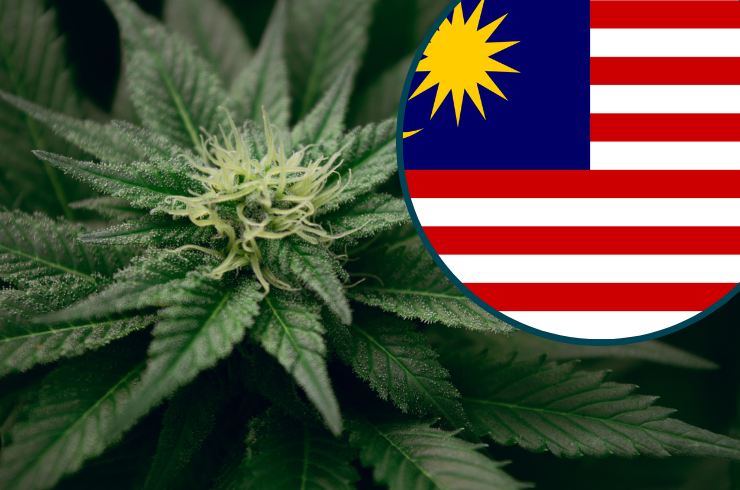
Quick answer: no, and Malaysia remains one of the most severe jurisdictions in the world on cannabis. Simple possession carries up to 5 years and a fine of up to RM20,000. Possessing 20 grams or more adds mandatory caning.
Trafficking still carries the death penalty, though since July 2023 it is a discretionary sentence rather than a mandatory one, and 200 grams of cannabis is enough to trigger a statutory presumption of trafficking.


Malaysia did not abolish the death penalty for drugs
This is the claim that gets repeated most often and it is wrong, so it belongs near the top.
The Abolition of Mandatory Death Penalty Act 2023, which received royal assent on 9 June 2023 and came into operation on 4 July 2023, removed the mandatory element. It did not remove the death penalty.
A judge convicting someone of trafficking under section 39B of the Dangerous Drugs Act 1952 may still impose death, and Malaysian courts have continued to do so: of 15 death sentences recorded in 2025, seven were drug-related.
What the 2023 Act did to section 39B was specific. It reduced the minimum caning from fifteen strokes to twelve, and it deleted subsections (2A) and (2B). Those deleted subsections were the real constraint.
A 2017 amendment had allowed life imprisonment instead of death, but only where narrow statutory conditions were satisfied, broadly that the accused was a courier who had assisted enforcement agencies. Removing them left judicial discretion unfettered.
A second point that is widely garbled: the sentence of 30 to 40 years that you see quoted is not the alternative to death for a fresh trafficking conviction. For a new section 39B conviction the alternative is imprisonment for life plus not fewer than twelve strokes of the cane.
The 30 to 40 year band comes from two other places: the 2023 Act replaced the sentence of “imprisonment for natural life” with a fixed 30 to 40 year term across the statutes it amended, and the separate resentencing regime produced terms in that range.
What Malaysian law says about cannabis
Cannabis is controlled by the Dangerous Drugs Act 1952, Act 234, which sets out a ladder of offences defined by weight.
Section 6 creates the base offence of unauthorised possession. Section 39A creates two enhanced-punishment tiers that bite at 20 grams and at 50 grams. Section 39B creates the trafficking offence. And section 37(da) creates a statutory presumption: a person found with 200 grams or more of cannabis, or 200 grams or more of cannabis resin, is presumed to be trafficking unless they prove otherwise.
That presumption operates alongside section 37(d), which presumes possession from being found with the drug. The combined effect, criticised by academics as a double presumption, is that the burden sits on the defendant at both stages.
Penalties for cannabis in Malaysia
Base possession under section 6 carries a fine of up to RM20,000, or up to 5 years in prison, or both.
At 20 grams the picture changes sharply. Section 39A(1) applies to 20 grams or more but less than 50 grams of cannabis or cannabis resin, and carries 2 to 5 years plus caning of not fewer than 3 and not more than 9 strokes. The caning is expressed as a mandatory addition to the prison term, not an alternative to it.
Section 39A(2) applies at 50 grams or more and carries imprisonment for life, or a term of not less than 5 years, plus caning of not fewer than 10 strokes.
At 200 grams the trafficking presumption under section 37(da) engages, and a section 39B conviction carries death or imprisonment for life, with not fewer than 12 strokes where death is not imposed.
In practice, caning is not carried out on women or on men over the age of 50.
Penalties at a glance
| Quantity of cannabis or resin | Offence | Sentence |
|---|---|---|
| Any amount (base offence) | Possession, section 6 | Up to 5 years and/or fine up to RM20,000 |
| 20 g to under 50 g | Enhanced possession, section 39A(1) | 2 to 5 years plus 3 to 9 strokes |
| 50 g or more | Enhanced possession, section 39A(2) | Life, or not less than 5 years, plus not fewer than 10 strokes |
| 200 g or more | Presumed trafficking, sections 37(da) and 39B | Death or life imprisonment; not fewer than 12 strokes if not sentenced to death |
Weight thresholds and penalties are set by the Dangerous Drugs Act 1952. The caning minimum for trafficking fell from 15 to 12 strokes on 4 July 2023.
What resentencing changed, and what it did not
Malaysia ran a one-off resentencing programme alongside the 2023 reform, under a separate statute that gave the Federal Court temporary jurisdiction over prisoners already sentenced to death or natural life who had exhausted their appeals.
It came into force on 12 September 2023, opened a 90-day application window that closed in December 2023, and required the court to substitute a fixed term of 30 to 40 years for a natural-life sentence.
The numbers moved a long way. In February 2024 Malaysia had 1,078 people under sentence of death, of whom 705, or just over 65 percent, had been convicted of drug trafficking. In a landmark first review in November 2023 the Federal Court resentenced 11 drug traffickers, taking seven off death row and four off natural life, each to 30 years from the date of arrest, with twelve strokes for the two men under 50.
By late 2024 the government reported 866 sentences reduced in that year alone, and all review proceedings concluded by October 2024. By November 2025 the death row population stood at 97, the lowest figure on record.
But the programme is finished, and it applied only to people already sentenced. Anyone convicted of trafficking today is sentenced under the current section 39B, where death remains available. Roughly half of the new death sentences passed in 2025 were for drug offences.
Is medical cannabis legal in Malaysia?
There is a lawful pathway on paper and nothing on the shelf, which is the single most misreported fact about Malaysia.
Successive health ministers have said no amendment to the Dangerous Drugs Act 1952 is needed, because the Act does not prohibit products containing cannabis where they are registered as medicines.
Registration runs through the Drug Control Authority under the Control of Drugs and Cosmetics Regulations 1984, alongside the Poisons Act 1952 and the Sale of Drugs Act 1952, and requires sufficient scientific evidence of safe and effective use. Supply would then be by prescription only, through a registered medical practitioner or a licensed Type A pharmacist.
One product has ever been approved. Nabiximols, sold as Sativex, was registered in 2014 for moderate to severe spasticity in multiple sclerosis where other treatments had failed, and the registration holder withdrew it on 17 July 2017 for commercial reasons. No cannabis-derived medicine has been registered since, and as of 2025 the Health Ministry’s position was that none is currently registered for medical use.
So the accurate statement is that Malaysia permits registration in principle and has approved nothing in practice. A prescription or medical card from another country gives no protection whatsoever.
Cultivation for research, education or medical purposes requires authorisation from the Health Minister, and importing cannabis material requires approval from both the Ministry of Health and the Royal Malaysia Police, plus physical examination by the Department of Agriculture and quarantine clearance.
Is CBD legal in Malaysia?
No. CBD is treated as a medicine and a poison rather than as a consumer product, and no CBD product is registered with the Drug Control Authority, so anything sold retail is being sold unlawfully. CBD derived from cannabis also engages the Dangerous Drugs Act directly.
A tax change caused widespread confusion here in 2025. A 5 percent Sales and Service Tax line item covering the customs code for plants used primarily in pharmacy was read online as evidence of legalisation.
The Ministry of Finance issued a statement on 23 June 2025 saying the government had not changed any law regarding cannabis, that all prohibitions remained in force under the Dangerous Drugs Act 1952 and the Poisons Act 1952, and that a tariff classification is not an approval.
For travellers, the US State Department is explicit that it is illegal to bring drugs into Malaysia including marijuana, cannabis or CBD products, and warns that violators may face the death penalty, long prison sentences, or fines.
There is no operating industrial hemp licensing regime in Malaysia, and no low-THC carve-out from the Dangerous Drugs Act that could be verified from a government source.
Can you smoke weed in Malaysia as a foreigner?
No, and foreign nationality offers no mitigation. The Dangerous Drugs Act applies identically to citizens, residents and visitors, and the weight-based tiers do not soften for tourists.
The UK Foreign, Commonwealth and Development Office states in its Malaysia travel advice that the Malaysian authorities have a zero-tolerance policy to drug offences, that possession, trafficking and manufacture of illegal drugs including cannabis are serious offences, and that possessing drugs even in very small quantities carries arrest and detention, a long jail sentence, possible whipping, and a possible death sentence by hanging for trafficking.
It also warns that cases take many months to reach trial, and that airport detection equipment scans all baggage including that of transit passengers.
Transit through Kuala Lumpur International Airport puts a traveller inside Malaysian jurisdiction. A connection between two countries where cannabis is lawful does not change that.
Is Malaysia likely to reform its cannabis law?
There is an active discussion and no legislation. The Deputy Health Minister told a drug policy summit in 2025 that the government was exploring amendments to the Dangerous Drugs Act to focus more on treatment and rehabilitation, and said he was open to a decriminalisation policy for minor offences.
The context he cited is striking: around 85 percent of Malaysian drug arrests are for minor possession rather than trafficking, with 179,799 arrests recorded in 2023, up about 10 percent on the previous year.
That is a ministerial statement of intent, not a bill. Until something is tabled and passed, the framework above is what applies.
The Ministry of Health publishes the statute itself, and the Dangerous Drugs Act 1952 carries sections 6, 37, 39A and 39B in full. Note that the version hosted there is the Revised 1980 reprint, so it still shows the pre-2023 figure of fifteen strokes in section 39B and does not reflect the Abolition of Mandatory Death Penalty Act 2023.
Last reviewed: September 17, 2026.


Sign up for bi-weekly updates, packed full of cannabis education, recipes, and tips. Your inbox will love it.