
 Merch
Merch Medical card
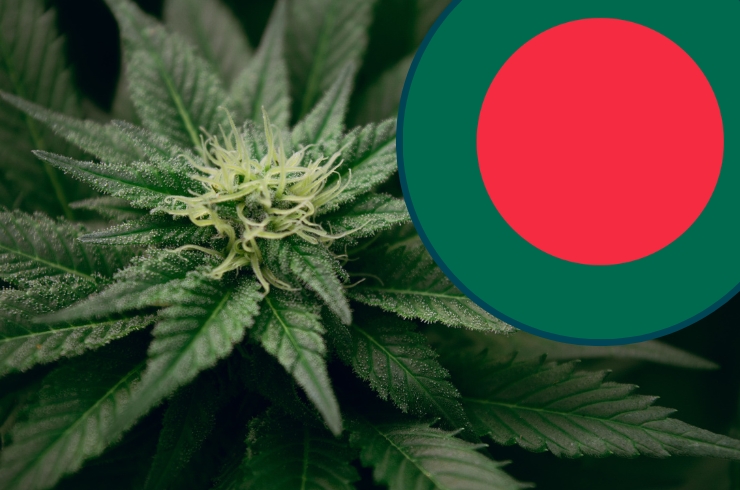
Quick answer: no. Cannabis is illegal in Bangladesh in every form, and the law splits the plant from its processed derivatives in a way that matters enormously. Holding any amount of herbal ganja up to 5 kilograms carries 6 months to 5 years in prison under the Narcotics Control Act 2018.
Holding hashish or cannabis resin is treated far more seriously, and above the statutory threshold it carries the death penalty or life imprisonment.


What Bangladeshi law says about cannabis
Cannabis is controlled under the Narcotics Control Act 2018, Act No. 63 of 2018, which repealed the Narcotics Control Act 1990 at section 69(1). Section 9 sets out the prohibitions and section 36 carries the penalty table, a 34-row schedule that fixes a different sentence for each substance class, each type of conduct and each quantity band.
Section 9 prohibits four distinct things, and the article you are charged under depends on which one you did. Section 9(1)(ka) covers cultivation, production, carriage, transport, import and export. Section 9(1)(kha) covers supply, sale, purchase, delivery, possession, storage and display. Section 9(1)(ga) covers consumption or use. Section 9(1)(gha) covers attempt, preparation, financing and sponsorship.
The Act schedules cannabis in two places. The plant itself, including branches, leaves, flowers and fruiting tops, sits in the lower Class B category. Cannabis resin, charas, hashish and THC are grouped with the Class A narcotics, alongside heroin and yaba. That single drafting decision is the most consequential fact in Bangladeshi cannabis law.
Penalties for ganja possession and personal use
Possessing herbal ganja carries 6 months to 5 years in prison plus a fine for any quantity up to 5 kilograms. Above that the bands step up: more than 5 and up to 15 kilograms carries 5 to 7 years, and more than 15 kilograms carries 7 to 10 years.
There is no de minimis threshold. A single joint sits in the same sentencing band as 4.9 kilograms, because the lowest band starts at zero and runs all the way to 5 kilograms. This is the point most readers get wrong.
Consumption is charged separately and more lightly. Smoking or otherwise using a Class B substance carries 3 months to 2 years plus a fine, with no quantity tiers at all.
The penalty table specifies no numerical fine for cannabis offences. Every cannabis row of section 36 says only “fine”, leaving the amount to the court, so any specific taka figure you see quoted for a cannabis fine is not coming from the statute.
Why hashish is punished far more harshly than ganja
Hashish and cannabis resin carry death-penalty exposure at quantities measured in grams, not kilograms. Because they sit in the Class A group rather than with the plant, the thresholds are roughly a thousand times lower.
For possession, sale, supply or storage, up to 10 grams carries 1 to 5 years, more than 10 and up to 50 grams carries 5 to 10 years, and above 50 grams the sentence is death or life imprisonment plus a fine. For cultivation, production, transport, import or export the bands are tighter still: up to 5 grams carries 1 to 5 years, 5 to 25 grams carries 5 to 10 years, and above 25 grams the sentence is death or life imprisonment.
So a person carrying 60 grams of hashish faces a capital charge, while a person carrying 4 kilograms of herbal ganja faces 6 months to 5 years. Same plant, entirely different exposure.
The “2 kilograms” figure circulating online is out of date
A widely repeated claim holds that 2 kilograms of cannabis triggers the death penalty in Bangladesh. That figure comes from the repealed Narcotics Control Act 1990, where cannabis resin above 2 kilograms attracted death or life imprisonment.

Under the 2018 Act the resin threshold is 25 grams for cultivation and transport offences and 50 grams for possession and supply, and herbal cannabis carries no death penalty at any quantity.
Anyone relying on the 2 kilogram figure is therefore working from a repealed statute and is wrong in both directions at once.
Penalties at a glance
| Substance and conduct | Quantity | Sentence |
|---|---|---|
| Ganja – possession, sale, supply, storage, transport | Up to 5 kg | 6 months to 5 years plus fine |
| Ganja – same conduct | Over 5 kg to 15 kg | 5 to 7 years plus fine |
| Ganja – same conduct | Over 15 kg | 7 to 10 years plus fine |
| Ganja – consumption or use | Any | 3 months to 2 years plus fine |
| Ganja – cultivation | Up to 50 plants | 1 to 5 years plus fine |
| Ganja – cultivation | Over 50 to 500 plants | 5 to 7 years plus fine |
| Ganja – cultivation | Over 500 plants | 7 to 10 years plus fine |
| Hashish or resin – possession, sale, storage | Up to 10 g | 1 to 5 years plus fine |
| Hashish or resin – possession, sale, storage | Over 10 g to 50 g | 5 to 10 years plus fine |
| Hashish or resin – possession, sale, storage | Over 50 g | Death or life imprisonment plus fine |
| Hashish or resin – cultivation, transport, import, export | Over 25 g | Death or life imprisonment plus fine |
All tiers are set by section 36 of the Narcotics Control Act 2018. The Act specifies no numerical fine for cannabis rows.
How repeat offences and the burden of proof work
A second conviction after serving a sentence doubles the maximum penalty under section 36(2), unless death or life already applies. A third conviction carries a minimum of 20 years under section 36(3).
Procedure works against a defendant in several ways at once. Section 55 creates a statutory presumption: being found in possession of narcotics or associated equipment raises a presumption that the Act was violated, shifting the burden onto the accused.
Drug offences are cognizable under section 46, so police can arrest without a warrant, and section 47 restricts bail. Section 51 requires trial within 90 working days, extendable to 135, though the practical reality is considerably slower.
What the July 2026 amendment changed
Parliament passed a further amendment to the Narcotics Control Act on 14 July 2026, gazetted on 16 July 2026. Reporting on the bill describes three significant changes, though the operative section numbers have not yet appeared in an accessible official text.
The amendment creates a drug trafficking offence committed through digital platforms and cyberspace, punishable by imprisonment for any term or the death penalty together with a fine of up to 20 lakh taka.
Where an organised or international criminal network is involved, the fine rises to up to 50 lakh taka. Critically, physical recovery of the drugs is no longer required to prosecute a digital-platform offence.
An earlier amendment, gazetted on 8 November 2020, restructured the Act’s court and prosecution provisions but left the schedules and the cannabis tiers untouched.
Treatment instead of prison: a narrow exception
Section 36(4) lets a court send an addicted defendant to a drug addiction treatment centre rather than to prison, but two conditions make it far less generous than it sounds. The treatment is at the defendant’s own expense or their family’s, and refusing it converts the disposal into a prison term of 6 months to 5 years.
The Act also provides at section 61 for a register of drug-dependent persons and for the establishment of treatment and rehabilitation centres. Reporting on the 2026 amendment says rehabilitation provisions were expanded, though the detail is not yet verifiable.
Is CBD legal in Bangladesh?
There is no CBD-specific provision in Bangladeshi law, and no regulator has published guidance naming cannabidiol. That absence is not permission.
CBD extracted from the cannabis plant falls within the section 36 wording covering any narcotic prepared from the branches, leaves or flowers of the cannabis plant, which puts it in the same band as herbal ganja.
Treat this as the legal reading rather than a published rule: no Bangladeshi authority has stated a CBD position either way, and customs and the Department of Narcotics Control in practice treat cannabis-derived products as prohibited.
Is there medical cannabis or legal hemp in Bangladesh?
No to both. Bangladesh operates no medical cannabis programme, no patient register and no prescribing route. The only opening is the general licensing provision at section 9(3), which permits approved pharmaceutical manufacture, industrial use, medical treatment and scientific research under licence, and it has never been used to create a cannabis programme.
The US State Department puts the practical position bluntly in its travel guidance, noting that possessing or importing drugs is illegal in Bangladesh even where medical marijuana is concerned.
Industrial hemp is equally prohibited. Bangladeshi law draws no THC threshold separating hemp from narcotic cannabis, so the plant is caught as such regardless of cannabinoid content, and there is no licensing scheme, pilot or exemption.
Academic work published in 2025 on reviving Bangladeshi hemp records that cultivation, sale, purchase, transport and possession of all forms of hemp remain illegal, and argues for creating a legal distinction that does not currently exist.
When ganja was legal: the shops that closed in 1989
Bangladesh ran licensed, government-regulated ganja shops until 1989. Ganja was a taxed economic crop in Bengal from the late eighteenth century, centred on Naogaon district, where the Naogaon Ganja Cultivators’ Cooperative Society, registered in 1917, held a monopoly granted under British administration and sold through licensed vendors at government-fixed rates.
Cultivation was wound down across the mid-to-late 1980s as Bangladesh implemented its obligations under the international drug conventions, and retail sales ended in 1989. The Narcotics Control Act 1990 followed the closure rather than causing it. Scholarly accounts differ on the exact year cultivation stopped, which is why this is usually given as a period rather than a date.
What happens to travellers and foreign nationals
Enforcement is heavy and high-volume, and cannabis is what it mostly catches. Department of Narcotics Control figures reported in 2026 record roughly 1.2 million narcotics cases filed between 2009 and July 2025, involving more than 1.5 million accused, with cannabis accounting for over 99 percent of total seizures by weight.
The UK Foreign, Commonwealth and Development Office states in its Bangladesh travel advice that there are severe penalties for possessing and trafficking illegal drugs, and that some drug-related offences are punishable by the death penalty or life imprisonment. It also warns that prison conditions fall far below UK standards and that judicial delays can mean long detention before a hearing.
The Act itself contains no deportation provision for drug offenders. Foreign nationals are prosecuted and imprisoned under the same tiers as Bangladeshi citizens, and any removal would come afterwards under immigration law rather than as an alternative to prosecution. Do not assume a tourist gets a lighter route.
Is Bangladesh likely to relax its cannabis law?
Nothing suggests it. The 2020 and 2026 amendments both moved in a punitive direction, adding offences and penalties rather than removing them, and the 2026 amendment introduced a fresh capital offence. Academic advocacy for reviving hemp and the Naogaon cultivation tradition exists, but it is scholarly rather than governmental, and no bill or ministerial proposal has taken it up.
For the full penalty schedule, the Ministry of Law publishes the statute on its Laws of Bangladesh portal, including section 36 of the Narcotics Control Act 2018, which carries every quantity threshold and prison term set out above.
Last reviewed: September 17, 2026.


Sign up for bi-weekly updates, packed full of cannabis education, recipes, and tips. Your inbox will love it.