

 Merch
Merch Medical card
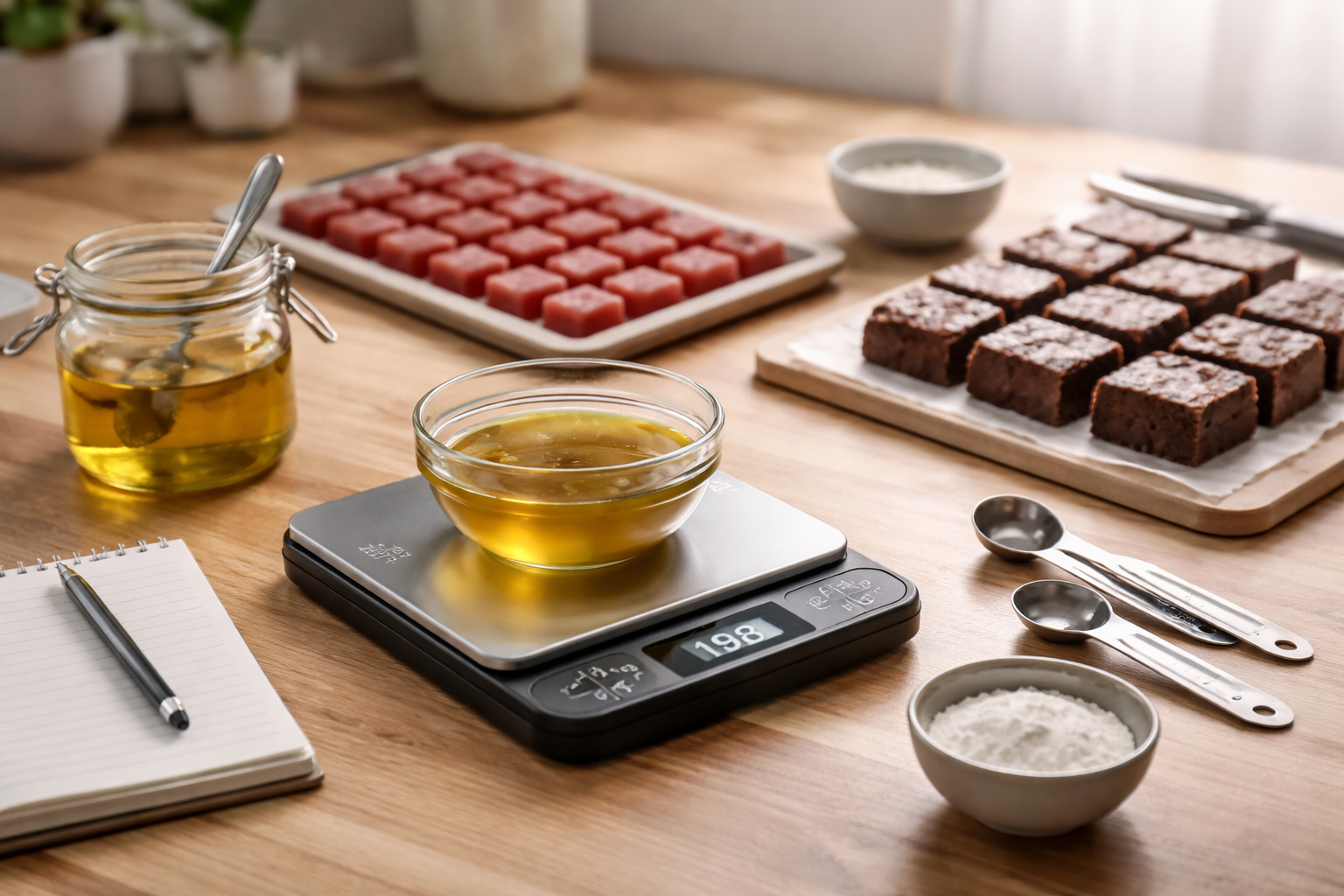
A step-by-step guide to turning flower into edibles with predictable milligram doses per serving—plus how your body processes them so you can avoid the most common dosing mistakes.
Here’s the thing about edible mishaps: the problem usually isn’t eating too much—it’s not knowing how much you’re eating. Even commercial cannabis edibles can vary significantly from their labeled doses, and when you’re making your own, the variables multiply. But with straightforward math and an understanding of how your body actually processes oral cannabis, you can make edibles that deliver consistent, predictable effects.

Let’s walk through it step by step.
Start with Your Flower’s Actual Potency
Everything hinges on the THC percentage printed on your flower’s packaging. The math is simple: multiply grams by THC percentage, then by 1,000 to get total milligrams. One gram of 20% THC flower contains approximately 200 mg of THC. Five grams would give you about 1,000 mg to work with.
Here’s the catch: THC percentages represent averages, not guarantees. Cannabis potency varies between plants and even within the same plant. Treat these numbers as your best estimate, not absolute truth.
The Reality of Decarboxylation and Infusion
Not all the THC in your flower makes it into your final product. Decarboxylation and infusion typically result in 10–25% loss, depending on your method, temperature, and timing. You’re essentially converting THCA (the non-psychoactive form) into THC through heat, and some cannabinoids inevitably get left behind or degraded.
A conservative approach assumes about 75–80% efficiency. Using five grams with 1,000 mg total THC, you’d estimate around 750–800 mg of active THC in your finished infusion. The key is using the same method consistently so you can refine your estimates over time.
Quick calculation: Total mg THC in flower × 0.75 (75% efficiency) = estimated active THC in your infusion
Calculating Milligrams Per Serving
Once you know the total active THC in your batch, divide by the number of servings. If your infused butter contains 750 mg of THC and you’re making 75 gummies, each gummy contains approximately 10 mg THC. For 50 brownies from the same batch? Each brownie would contain about 15 mg.
This simple division is the foundation of accurate dosing. But—and this matters a lot—it only works if your THC is evenly distributed throughout the batch.
Mix Thoroughly (Seriously, More Than You Think)
Homogeneity is the technical term for even distribution, and it’s critical. Without it, one brownie might contain 5 mg while another packs 25 mg, even though your math was perfect. Research on homemade edibles consistently shows uneven cannabinoid distribution as a primary source of unpredictable effects.
To ensure consistent dosing: warm your infusion slightly to reduce viscosity, stir thoroughly for several minutes while scraping sides and bottom, portion quickly before ingredients separate, and avoid recipes with large density differences between components (oil and water-based ingredients don’t naturally mix well).
Understanding How Your Body Processes Edibles
Here’s where many people go wrong: they take a dose, don’t feel anything after 45 minutes, and take more. Then both doses hit at once, and the experience becomes overwhelming. Understanding oral cannabis pharmacokinetics helps you avoid this trap.
When you consume cannabis orally, effects typically begin 30–60 minutes after ingestion, peak around 1.5–3 hours, and last six to eight hours or longer. Research on oral cannabis doses from 10 mg to 50 mg shows higher doses intensify effects and extend duration—but the timeline remains fairly consistent.
Wait until you’ve experienced the full peak of your first dose—usually at least three hours—before considering taking more.
Why Individual Responses Vary
Two people taking the same 10 mg dose may have notably different experiences based on gut absorption, metabolism, body composition, and tolerance. This makes personal experimentation and documentation essential—what works for your friend might not work for you.
Track Your Process and Refine
Accurate dosing improves with record-keeping. Track your flower strain and THC percentage, grams used and calculated mg, decarb method and temperature, number of servings and mg per serving, plus consumption details: timing, food intake, onset time, peak intensity, and duration.
After several batches using the same method, you’ll determine whether your efficiency estimate is accurate. Consistently stronger effects than expected? Your actual efficiency might be closer to 85%. Weaker than anticipated? Perhaps 70% is more accurate for your process.
The Bottom Line
Homemade edibles involve inherent variability—flower potency fluctuates, decarboxylation efficiency changes with temperature, and thorough mixing doesn’t guarantee perfect distribution. The goal isn’t laboratory precision but a consistent, repeatable process that gives predictable results within a reasonable range.Start with conservative dose estimates, especially with new batches. Give each dose adequate time to reach full effect before redosing. Use dosage calculators to verify your math. With this systematic approach—calculating total THC, adjusting for efficiency, dividing by servings, mixing thoroughly, and timing doses appropriately—you’ll develop the skills to make edibles that deliver the experience you’re looking for, not a surprise you didn’t sign up for.


Sign up for bi-weekly updates, packed full of cannabis education, recipes, and tips. Your inbox will love it.