

 Merch
Merch Medical card
How California, Colorado, and Oregon reshaped American cannabis policy
On January 1, 2014, Colorado made history when the world’s first legal recreational cannabis stores opened their doors. Lines stretched around city blocks as curious consumers and cannabis advocates witnessed a milestone that seemed impossible just decades earlier. This moment marked the culmination of nearly a century of policy evolution—from racialized prohibition campaigns to medical acceptance to full legalization.

The Roots of Prohibition: Moral Panic and Racialized Policy
The early criminalization of cannabis wasn’t driven by medical science or public health data. Instead, it emerged from racist and anti-immigrant narratives that targeted Mexican and Black communities during the early 20th century. State-level bans began appearing in the 1910s and 1920s, fueled by moral panic rather than evidence.
Harry Anslinger, the first commissioner of the Federal Bureau of Narcotics, became prohibition’s chief architect. His propaganda campaign used inflammatory rhetoric linking cannabis to violence and moral degeneracy, explicitly targeting communities of color. This legal history of cannabis prohibition reveals how policy was shaped by prejudice rather than pharmacology.
Federal Consolidation: The Tax Act and Schedule I
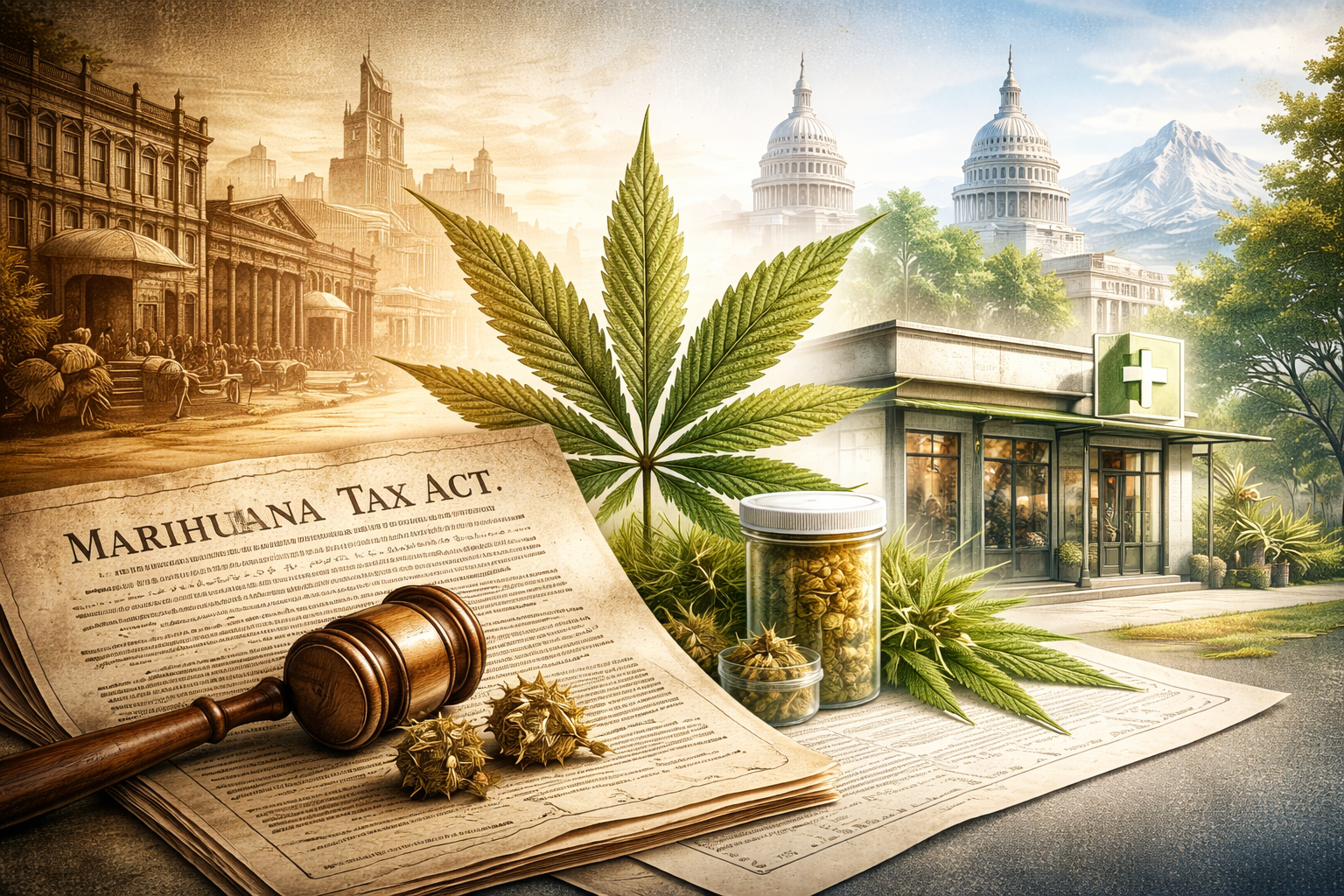
Two federal laws cemented cannabis prohibition for generations. The Marihuana Tax Act of 1937 effectively banned cannabis through burdensome taxation and registration requirements. Then, the Controlled Substances Act of 1970 classified cannabis as Schedule I—defined as having no accepted medical use and high abuse potential.
As this Congressional Research Service report explains, Schedule I classification created massive barriers to medical research and state-level reform. The designation contradicted growing clinical evidence about cannabis’s therapeutic potential, creating a credibility gap that would eventually fuel the medical cannabis movement.
California’s Medical Cannabis Revolution
Everything changed on November 5, 1996, when California voters approved Proposition 215—the Compassionate Use Act. This groundbreaking measure allowed patients with serious conditions to use and cultivate cannabis with a physician’s recommendation, making California the first state to challenge federal prohibition through medical access.
Proposition 215 didn’t just change California law—it sparked a nationwide movement. The measure created legal protections for patients and caregivers, though it left many regulatory questions unanswered. Subsequent legislation like Senate Bill 420 established the Medical Marijuana Program, creating identification cards and cultivation guidelines that shaped how other states would approach medical cannabis.
Twenty years later, California voters approved Proposition 64—the Adult Use of Marijuana Act—creating a dual regulatory system that continues to evolve.
Colorado and Oregon: Pioneering Full Legalization
Colorado followed California’s medical lead with Amendment 20 in 2000, establishing constitutional protections for medical cannabis patients. But Colorado would make even bigger waves in 2012 when voters approved Amendment 64, legalizing adult-use cannabis and creating the regulatory framework that would govern the world’s first legal recreational market.
The amendment specified possession limits (up to one ounce for adults 21+), home cultivation rights (up to six plants), and directed the state to establish licensing for commercial cannabis businesses. When sales began in 2014, Colorado provided a real-world test case that other states—and countries—would watch closely.
Oregon charted its own path, becoming the first state to decriminalize small-amount possession in 1973. The Oregon Medical Marijuana Act passed in 1998, and voters approved Measure 91 in 2014, establishing adult-use legalization that took effect in 2015. Oregon’s progressive approach demonstrated that states could craft cannabis policies reflecting their own values and priorities.
The Federal-State Conflict
Despite widespread state-level legalization, cannabis remains a Schedule I controlled substance under federal law. This creates ongoing conflicts around banking access, interstate commerce, and research funding. The legal and constitutional tensions between state reforms and federal prohibition continue to shape policy debates.

This disconnect has real consequences. Cannabis businesses often operate cash-only because federal banking regulations create risks for financial institutions. Researchers face bureaucratic hurdles that limit clinical studies, even as evidence on medical applications continues to grow.
Looking Forward: A Shifting National Landscape
Today’s cannabis policy landscape reflects decades of state-level experimentation and evolving public opinion. As of 2024, 38 states have legalized medical cannabis, and 24 states have approved adult-use programs. The timeline of reform continues to accelerate.
Federal proposals around rescheduling, decriminalization, and banking reform suggest that national policy may eventually catch up to state-level changes. The experiences of pioneering states like California, Colorado, and Oregon have provided valuable data on regulation, tax revenue, public health impacts, and social equity considerations.
What began with racialized prohibition campaigns has transformed into a complex patchwork of medical and recreational programs, each reflecting different approaches to regulation, taxation, and social justice. The journey from criminalization to legalization continues to reshape American cannabis policy—one state, one vote, one reform at a time.


Sign up for bi-weekly updates, packed full of cannabis education, recipes, and tips. Your inbox will love it.