

 Merch
Merch Medical card
Medical cannabis policy is entering a new phase, and patients cannot afford for states to treat it like business as usual.
For almost three decades, people who use cannabis therapeutically have had to balance conflicting laws and protections at the state and federal levels. That is finally starting to change.

AG Order No. 6754-2026 has opened a new federal pathway for qualifying state-licensed medical cannabis businesses to seek DEA registration, giving new practical significance to state medical cannabis systems and patient documentation. For the first time, the federal government is recognizing state medical cannabis systems in a practical way, distinguishing regulated medical cannabis from the broader cannabis market. That is a major shift after decades of advocacy by patients, caregivers, clinicians, researchers, and organizations working to move cannabis out of political limbo and into healthcare policy.
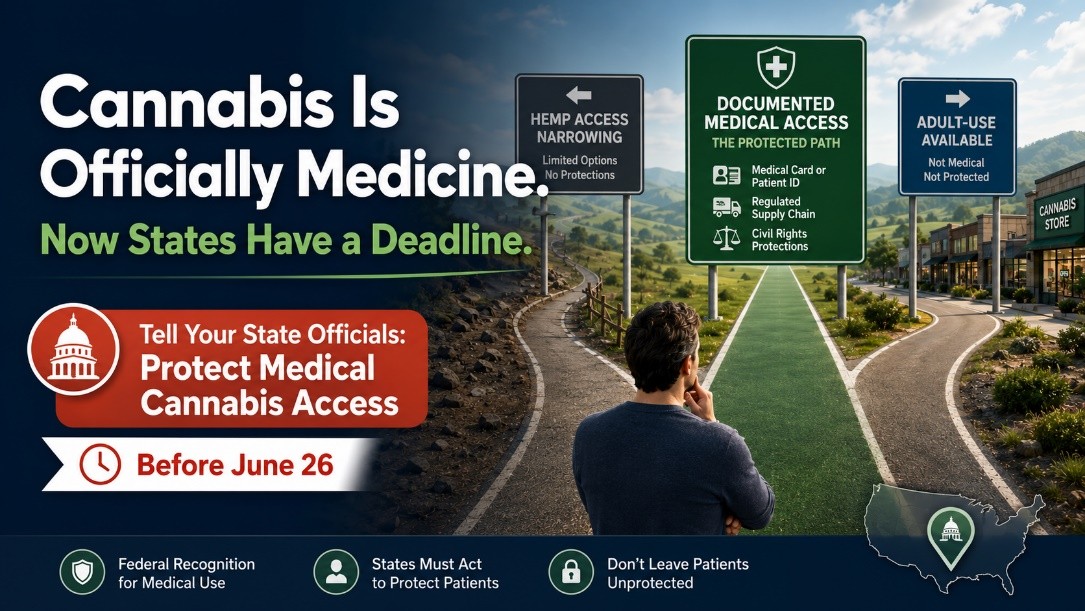
But there is a catch. A patient’s access now depends, in part, on the quality of their state program and the ability of their cannabis providers to register with the DEA by June 26. The fast-approaching DEA registration deadline creates an immediate test for states. If state officials fail to act quickly, patients could have federal protections on paper without reliable access to their medicine.
Why June 26 matters for patients
Americans for Safe Access is urging patients, advocates, cannabis businesses, and industry organizations to contact governors, state legislators, cannabis regulators, health departments, and attorneys general now and demand a plan to protect and expand safe access.
ASA has already built state guidance and action resources to help patients and advocates contact state officials.
States must educate patients and licensees, issue state verification letters for businesses applying for DEA registration, and automatically clear eligible cannabis conviction records. In states with both adult-use and medical programs, officials will also need to rebuild patient enrollment systems and create or restore medical-only supply chains. That is not just some abstract housekeeping policy, but instead is the actual infrastructure patients need for federal recognition to apply to their reality.
The access problem states helped create
This is not a minor administrative problem. It is a patient access problem. For years, many states have allowed their medical cannabis programs to weaken, shrink, or merge into broader adult-use markets. In some places, medical cannabis patients still have strong program infrastructure, clear registration systems, and medical-only supply chains. In others, patients were effectively pushed into adult-use stores because medical dispensaries disappeared, product availability shifted, physician participation declined, or state systems became too expensive or difficult to navigate.
For many patients, cannabis access has already been a rollercoaster. Some enrolled in state medical programs and stayed there, renewing cards and following the rules year after year. Others left those programs once adult-use stores became easier to access, cheaper, or less stigmatizing. Some never enrolled at all because the process was too expensive, too confusing, too limited, or too invasive. Many patients, especially those looking for CBD-rich or lower-intoxication products, ended up relying on hemp products because that was where the products they needed were easiest to find and more affordable.
Hemp filled a gap, and that gap may get wider
That last group matters more than many policymakers seem to understand. Hemp-derived products have not only been used by casual consumers chasing novelty. They have also been used by patients trying to manage pain, sleep, anxiety, seizures, cancer-related symptoms, appetite, inflammation, and other serious or chronic concerns. In some cases, patients turned to hemp because their state medical program was weak. In others, patients were effectively pushed there because dispensaries increasingly deprioritized balanced products. In many circumstances, adult-use shelves have been dominated by high-THC flower, vapes, concentrates, and edibles, products that do not always match what patients are looking for.
Was the hemp market perfect? Absolutely not. Not even close. There have been serious problems with intoxicating products, inconsistent testing, poor labeling, youth access, questionable claims, contamination, and synthetic products that should never have been treated like ordinary consumer goods. But if lawmakers focus only on closing loopholes and do not build a replacement pathway for patients, the people affected most are not just bad actors in the hemp space. Patients lose, too. Weird how that keeps happening.
Federal hemp law changes may make many hemp-derived cannabinoid products much harder to access, including products that have been filling gaps left by state medical programs and adult-use markets. We may be heading toward a strange and frustrating moment: cannabis is finally being acknowledged as medicine, while many patients lose access to the cannabinoid products they have been using as medicine. That should make all of us uncomfortable.
Adult-use access is not medical access
Adult-use cannabis remains outside the federal medical cannabis framework. Hemp-derived products are also outside this pathway. Patients who rely on those products, or who let their medical cannabis registrations expire because adult-use access seemed easier, may not have the documentation they need to benefit from the new federal medical cannabis framework. States need to tell patients this clearly and immediately.
But these changes are also about more than just accessing cannabis-based medicine. They are about whether patients can point to a recognized medical status when they face housing rules, workplace policies, healthcare restrictions, long-term care barriers, custody questions, or public benefit systems that still treat cannabis as disqualifying.

Rights do not enforce themselves, and patients are in a stronger position when states give them documentation, education, and a functioning medical cannabis program to stand on.
They also need to make it easy for patients to fix the problem. That means emergency renewal options, affordable registration, confidential enrollment, telehealth where allowed, fee waivers for low-income patients, and simple pathways for patients who previously left medical programs to return. A state medical cannabis card should not become a privilege available only to patients with enough time, money, or bureaucratic stamina to navigate a difficult system.
Businesses need guidance too
The June 26 deadline also raises urgent questions for cannabis businesses that serve patients. DEA registration will not be available simply because a company holds some kind of state cannabis license. The Order created a pathway for certain qualifying state-licensed medical cannabis activity. Businesses will need to understand whether they are eligible, whether their state license documents medical activity, and whether their operations can be distinguished from adult-use activity.
States should not leave businesses to figure this out on their own. Cannabis regulators and health departments should issue guidance, provide verification letters, and educate licensees about the DEA registration opportunity, the June 26 deadline, and the risks of assuming that all state-legal cannabis activity now receives federal protection. That assumption would be wrong. Federal movement on medical cannabis does not erase the legal difference between medical and adult-use activity. It does not automatically convert an adult-use store into a federally recognized medical provider. It does not fix expired patient registrations. It does not create a medical supply chain where states have allowed one to disappear.
States cannot sit this one out
State action is what turns this federal opening into real patient protection. Americans for Safe Access has released State Preparedness for Federal Cannabis Regulation & Enforcement: Part 1, State Actions Needed to Preserve & Protect Patient Access Before the June 26, 2026, DEA Registration Deadline, along with the webinar “Emergency Action Needed. Are States Prepared for June 26 DEA Medical Cannabis Registration?” The guidance urges governors, legislators, cannabis regulators, health departments, and attorneys general to move quickly.
The recommendations are practical and urgent. States should help patients enroll, renew, or re-enter medical cannabis programs. They should educate patients that current medical cannabis documentation may now carry new practical legal significance. They should issue state verification letters for eligible medical cannabis businesses. They should restore or preserve medical-only supply chains. They should also clear eligible cannabis records so old convictions do not block patients, caregivers, workers, owners, or legacy operators from participating in the emerging federal medical cannabis framework.
Record clearing is part of patient access
Record clearing is not a side issue. It is an inherent part of restoring access. Patients and caregivers should not be punished twice, first under outdated cannabis laws and then again by being excluded from a system built after those laws began to change. Workers and legacy operators should not be shut out of the medical cannabis infrastructure that patients may now depend on. If states want this transition to be fair, automatic record clearing must be part of the response.
Every state has work to do
We must also consider that the needs vary by state. Adult-use and dual-market states need to rebuild or protect medical cannabis systems that may have been weakened by market consolidation. Medical-only states need to make sure patients and businesses are prepared to document their status quickly and accurately. CBD-only, low-THC, limited-program, and no-program states face the most serious gaps and should move quickly to create meaningful pathways for patient documentation and medical access.
ASA’s role in this moment
Before joining the board of Americans for Safe Access, I knew ASA did important work. I had seen the reports, the advocacy, the patient education, and the years of persistence it took to get medical cannabis policy this far.
Now that I have seen more of the work from inside the organization, I can say this plainly: ASA’s role matters as much as ever right now. This is the kind of moment when patients need more than slogans. They need timelines, guidance, state-by-state action, policy expertise, and advocates who can stay in the rooms where these decisions are being made.
And that kind of work takes people, time, expertise, and resources.
So support the work however you can. Become a member. Buy a T-shirt. Give $50. Become a sponsor. Share ASA’s resources. Send them to your state officials. We do not all have to do the same thing, but we do have to do something, and we are strongest together.
Patients and advocates need to make noise
Patients and advocates have a major role to play right now. They should contact their governor, state legislators, cannabis regulators, health department, and attorney general, and ask whether their state is preparing for the June 26 DEA registration deadline. They should ask whether patients are being notified, whether medical cannabis businesses are receiving guidance, whether the state can issue verification letters, and whether medical-only supply chains are being preserved.
The message to state officials should be direct: federal cannabis policy has changed, and patients need states to act before the deadline passes. This is a rare moment in cannabis policy, but the details will determine whether patients benefit. A new federal pathway could strengthen medical cannabis access, support better integration into healthcare, and create stronger protections for patients. Or it could become another missed opportunity if states wait too long.
June 26 is not just a deadline for businesses and regulators. It is a deadline for patients. If your state is not ready, now is the time to make noise.


Sign up for bi-weekly updates, packed full of cannabis education, recipes, and tips. Your inbox will love it.