

 Merch
Merch Medical card
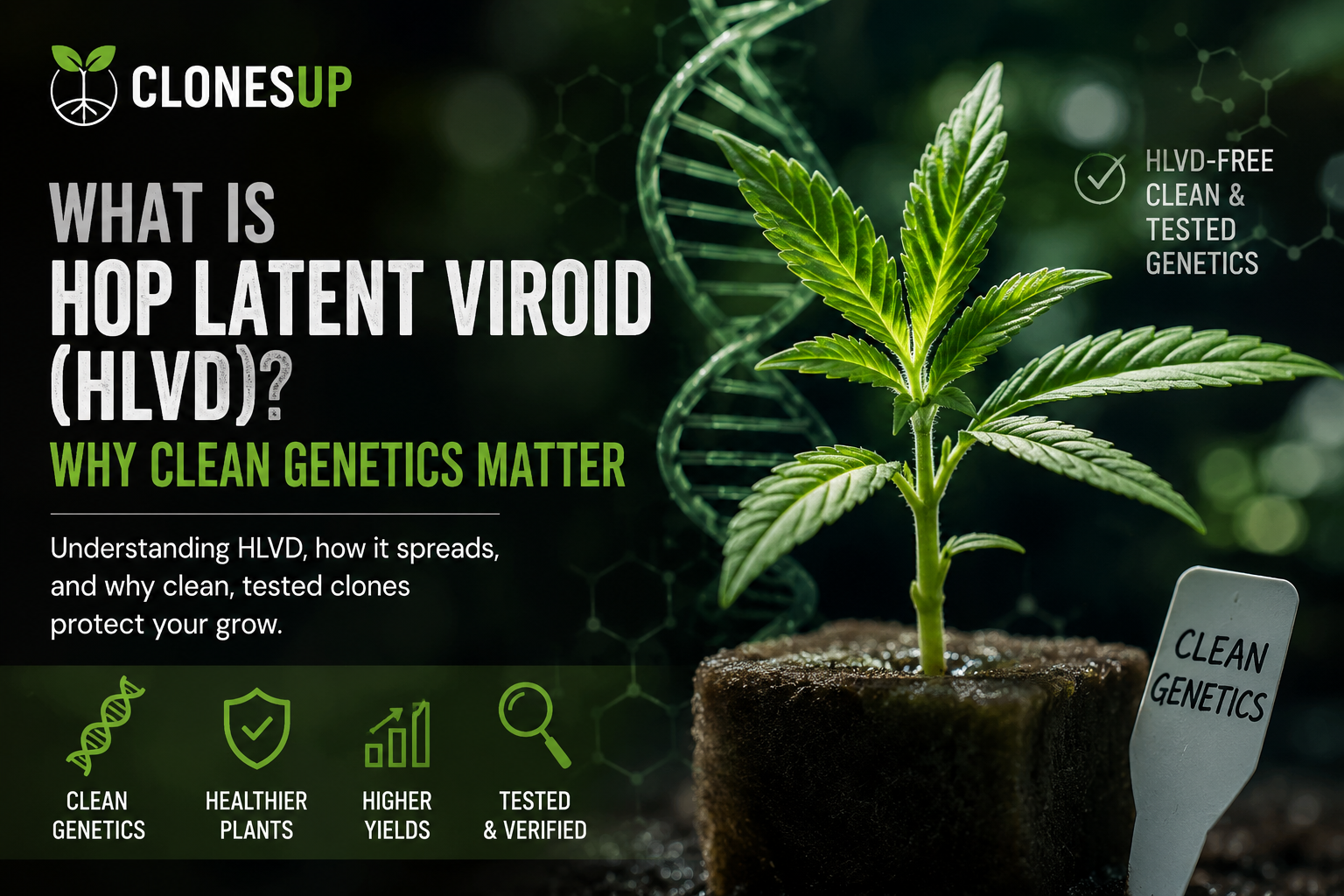
For most of the modern cannabis era, growers worried about the things they could see: spider mites on the underside of a leaf, powdery mildew dusting a canopy, root rot creeping up from an overwatered pot. Hop latent viroid is different. It is largely invisible until harvest, it spreads through the everyday act of taking a cutting, and by some estimates it is quietly draining billions of dollars a year from an industry that mostly didn’t know it was there.
If you have heard growers start talking about “clean genetics,” “HLVd-free,” or “tested mothers” over the past couple of years, this is why. Here is what the science actually says.

First, what is a viroid?
A viroid is not a virus. It is smaller and stranger. Where a virus is a strand of genetic material wrapped in a protein coat, a viroid is just a short loop of naked RNA — a few hundred nucleotides with no protein shell and no genes that code for proteins at all. It is one of the smallest known infectious agents on Earth. It cannot do anything on its own; it hijacks the plant’s own cellular machinery to copy itself, and in the process it disrupts the plant’s normal gene regulation.
Hop latent viroid (HLVd, sometimes written HpLVd) was first characterized in hops, a close botanical cousin of cannabis, where it lives up to its “latent” name by often causing no obvious harm. In cannabis, it is anything but latent. Growers know the resulting condition by a blunter name: dudding, or dudding disease.
Why growers didn’t notice for years
The cruelty of HLVd is its timing. An infected clone can look completely healthy through its entire vegetative stage. It roots, it stretches, it puts out normal-looking leaves. The plant only reveals itself deep into flower — often in the back half of the flowering cycle — when the payoff should be arriving and instead doesn’t.
Symptomatic plants show stunted growth, brittle or malformed leaves, reduced vigor, and — the part that hits a grower’s wallet — smaller, airier buds with noticeably reduced trichome density and lower cannabinoid and terpene production. A controlled study of greenhouse cannabis in Canada documented reductions of roughly 12–42% in stem lengths, fresh weights, and plant heights in infected plants versus healthy ones, with some genotypes losing 28–39% of their THC at harvest (Canadian Journal of Plant Pathology, 2023).
That is the trap. Because the plant looks fine until it’s too late, a facility can propagate an infected mother into hundreds of clones, fill a flower room, and only discover the problem eight or nine weeks later in the form of a disappointing, low-potency harvest — with no obvious culprit.
How widespread is it, really?
Widespread enough that some researchers have called it “the COVID of cannabis” — not for its danger to people (it poses none), but for how quietly and thoroughly it spread through a connected industry before anyone was testing for it.
The numbers are sobering. A frequently cited figure estimates that as much as 90% of California cannabis carries HLVd, with associated losses approaching $4 billion a year in reduced yield and potency (Dark Heart Nursery survey, widely reported). A more conservative and systematic picture comes from Canada, where RT-PCR testing of 15,947 samples from nine provinces between 2020 and 2023 found an average infection incidence of 25.6%, ranging as high as 92% in some facilities — and HLVd turned up in 40% of dried flower samples pulled from dispensary shelves (Canadian Journal of Plant Pathology, 2023).
Whichever number you trust, the takeaway is the same: this is not a fringe problem affecting a few unlucky gardens. It is endemic.
How it spreads — and why cloning is ground zero
Here is the single most important fact for anyone who propagates plants: HLVd spreads mechanically. It moves through sap. Physical contact is enough.
That means the routine, repetitive tasks at the heart of cultivation are exactly the ones that transmit it — pruning, defoliating, trimming, and above all taking clones. A single contaminated blade drawn across an infected plant and then a healthy one can carry the viroid along. Because it lives in the plant’s vascular tissue, cutting a clone from an infected mother produces an infected clone, every time. It also persists in root systems and can move through a shared water or hydroponic reservoir.
Two pieces of good news from the research. First, HLVd is not efficiently transmitted through seed or pollen (New insights into HLVd transmission, 2024) — sexual reproduction is a relatively low-risk pathway, though not zero. Second, and more practically, the problem is preventable with discipline and testing.
The turn toward “clean genetics”
Because there is no spray, no nutrient, and no cure you can apply to an infected plant in the room, the entire strategy against HLVd is preventive. That strategy has three pillars, and together they are what the industry now shorthands as *clean genetics*:
1. Molecular testing. You cannot see HLVd, so you have to test for it. Labs use RT-qPCR (reverse-transcription quantitative PCR) and next-generation sequencing to detect the viroid’s RNA directly, often from a small leaf or root punch. Responsible nurseries test their mother plants on a schedule, not just once, because a mother can be infected between tests.
2. Sanitation and quarantine. Sterilizing blades and tools between every plant, isolating incoming genetics until they clear testing, and treating the propagation area as the cleanest room in the building. Most of an outbreak is preventable with sterile technique alone.
3. Clean starting material. Where infected genetics already exist but need to be saved, meristem tissue culture can rescue them: the viroid moves slowly through actively dividing meristem tissue, so culturing the tiny growing tip can yield viroid-free plantlets (review in Technology Networks). For everyone else, it simply means sourcing plants that have been tested and verified clean before they ever reach your garden.
What this means for the home and small-scale grower
If you run a commercial facility, HLVd management is now table stakes — an in-house or contracted testing program, strict tool hygiene, and a quarantine protocol. But the same logic scales all the way down to a single tent.
The highest-risk moment in any grow is the introduction of new genetics. A clone from a friend, a swap at a meetup, an untested cut of something exotic — that is precisely how the viroid enters a clean room. You can defoliate and prune with perfect technique for months and still lose a harvest to one infected clone you brought in on day one.
This is the practical case for buying from a source that tests. When a nursery maintains documented mother plants and screens them for HLVd, the guarantee you are actually paying for isn’t just “this is the strain on the label” — it’s “this plant will not quietly sabotage your flower room.” A supplier like ClonesUp, for instance, partners with a third-party lab (StrainLab) specifically for HLVd screening and publishes its clean-genetics and lab-testing policies, so a grower starting from a verified clone skips the single biggest disease risk in the whole cycle. If you are shopping for tested, female-guaranteed cuttings, that verification is the thing worth looking for — you can browse what verified, HLVd-screened clones look like here.
The bottom line
Hop latent viroid changed the rules quietly. For years, the cannabis industry optimized for potency, terpene profiles, and yield while an invisible RNA loop spread through the exact tools growers use to multiply their best plants. There is no cure to apply mid-grow, which is why the entire defense is upstream: test the mothers, sterilize the tools, quarantine the newcomers, and start from material you know is clean.
“Clean genetics” isn’t marketing jargon. It’s the recognition that in a world where the most valuable plants are copied by hand, thousands of times over, the health of the copy is only ever as good as the health of the original — and the only way to know is to test.
This article is for educational purposes. Cannabis cultivation laws vary by state and country; grow only where it is legal to do so.
Sources
- Symptomology, prevalence, and impact of Hop latent viroid on greenhouse-grown cannabis — *Canadian Journal of Plant Pathology* (2023)
- Transmission, Spread, Longevity and Management of Hop Latent Viroid in North America — *PMC* (2025)
- New Insights into Hop Latent Viroid Detection, Infectivity, Host Range, and Transmission — *PMC* (2024)
- Hop Latent Viroid is a major threat to the cannabis industry, review claims — *Technology Networks*
- HLVd’s Impact on the Cannabis Industry — *LeafWorks*


Sign up for bi-weekly updates, packed full of cannabis education, recipes, and tips. Your inbox will love it.