

 Merch
Merch Medical card
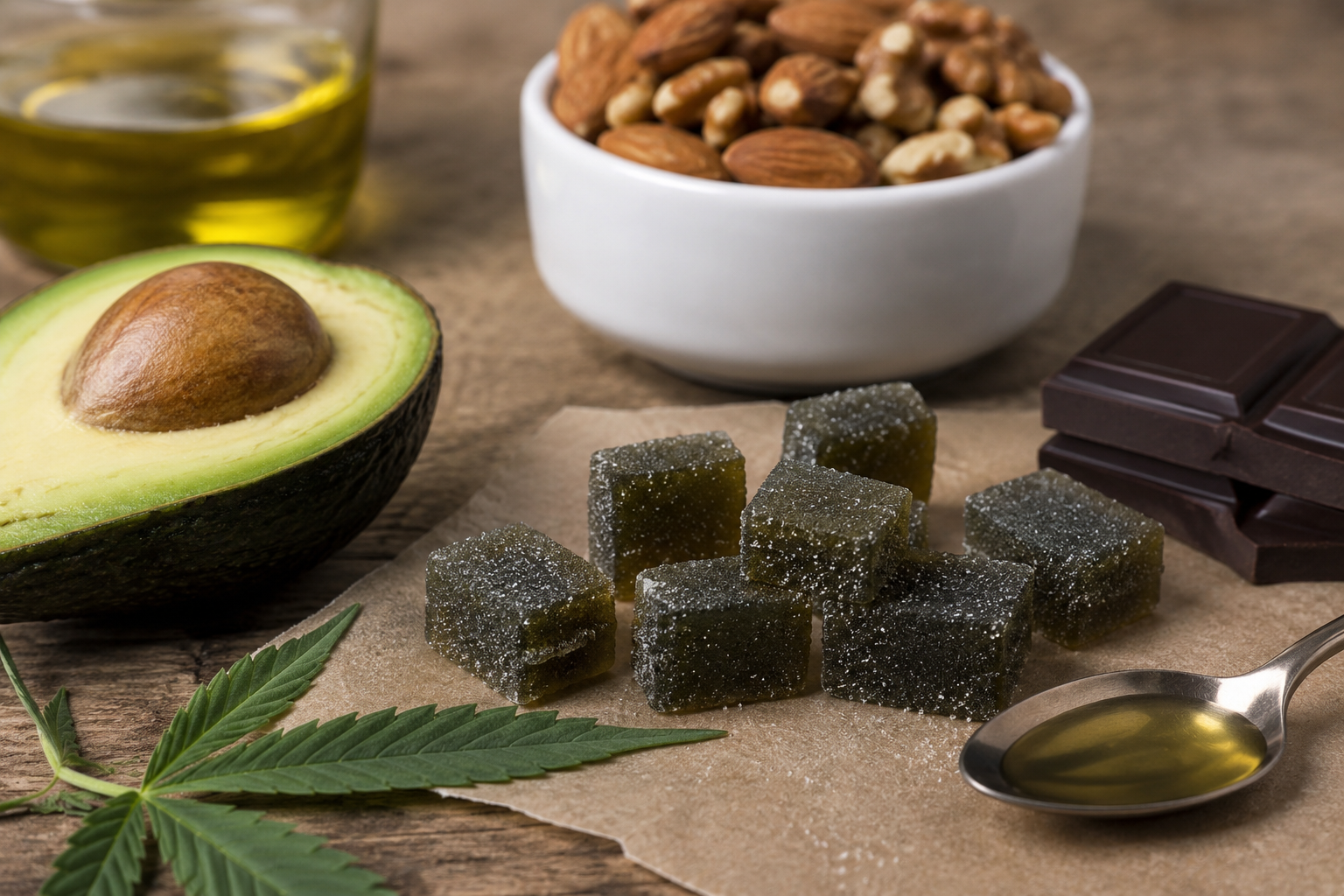
Everybody knows cannabis and fat go together. Cannabutter, infused oils, chocolates, brownies, gummies made with oil bases — fat is all throughout the cannabis edible world. Usually, that conversation stays pretty simple – cannabinoids like THC dissolve well in fat. And that is true.
But fat may be doing more than helping us make edibles. It may also change how your body handles THC after you take it. That is the part I want to focus on here.


A 2019 study by Lunn et al., published in Cannabis and Cannabinoid Research, looked at oral THC capsules under fed and fasted conditions. And while this was not a study of brownies, gummies, drinks, or homemade edibles, it gives us a clean look at something many cannabis consumers have wondered about – does taking THC with food change what happens in the body?
Before getting carried away in the details, a little grounding helps. This was a small study. It included 28 healthy adults. It used THC capsules, not brownies, gummies, drinks, or homemade edibles. The participants were healthy adults, not people with major medical conditions, and the study was industry-funded by Aurora Cannabis Inc. So this is not the final word on all oral cannabis pharmacokinetics. But still, it gives us a clean, well-controlled, and well-designed look at a question a lot of cannabis users have wondered about: does taking THC with food change what happens in the body?
All signs point to yes.
As the graphic below explains, the researchers gave 28 healthy adults oral THC capsules under four different conditions: 5 mg THC fasted, 5 mg THC after a high-fat meal, 10 mg THC fasted, and 10 mg THC after a high-fat meal. It was randomized, double-blind, and crossover, which is nice because each participant served as their own comparison across the different conditions. The “fed state” in this study was not just “not hungry.” It meant taking the THC after a standardized high-fat, high-calorie breakfast. The meal included eggs, toast, hash browns, whole milk, bacon, and butter, totaling roughly 954 calories with a lot of fat packed in.
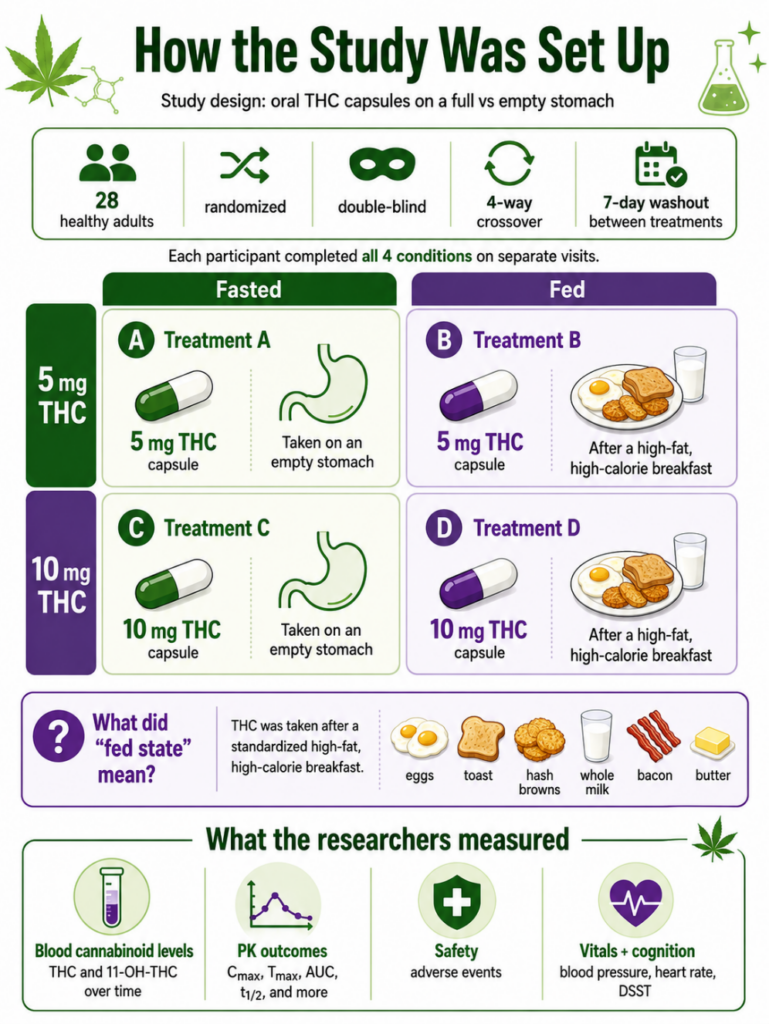
Graphical study summary (based on table 2) created with ChatGPT 5.5; based on Lunn S, Diaz P, O’Hearn S, et al. Human Pharmacokinetic Parameters of Orally Administered Δ9-Tetrahydrocannabinol Capsules Are Altered by Fed Versus Fasted Conditions and Sex Differences. Cannabis Cannabinoid Res. 2019;4(4):255-264. Published 2019 Dec 6. doi:10.1089/can.2019.0037
The researchers then measured blood levels of THC and 11-hydroxy-THC over time. If that second compound sounds familiar, it should. When you eat THC, your liver converts some of it into 11-hydroxy-THC, often written as 11-OH-THC. That metabolite is one big reason edibles often feel different from smoking or vaping. It is part of the “why edibles hit different” story, and if you want the longer version, Cannigma already has a good explainer on 11-hydroxy-THC.
Now to the findings, which the paper lays out in Table 7 and which are summarized in the graphic below.
For THC itself, the peak blood level, or Cmax, did not really change in a major way when people took the capsule with a high-fat meal. But the time to reach that peak, or Tmax, changed a lot. At 5 mg, the average THC peak shifted from about 1.9 hours in the fasted state to about 6.6 hours in the fed state. At 10 mg, it shifted from about 1.8 hours to 6.6 hours. In other words, THC took much longer to reach its peak after the high-fat meal.
The half-life of THC, meaning how long it takes the amount in the blood to drop by half, did not change much. But the area under the curve, or AUC, did increase. AUC is a pharmacokinetic way of describing total exposure to the drug over time. Think of it as the total amount of THC your body sees across the whole experience, not just the highest single point. In this study, THC AUC increased from 3.13 to 8.75 ng·h/mL at 5 mg, and from 8.71 to 17.60 ng·h/mL at 10 mg when the capsules were taken with a high-fat meal. So food did not just delay THC. It increased the body’s overall exposure to THC.
The study also found decreases in apparent clearance and apparent volume of distribution for THC in the fed state. For most readers, you do not need to live inside those terms. The plain-English version is that food appeared to change how THC moved through and cleared from the body, in a way that fits with longer and greater exposure overall.
The 11-OH-THC story was similar, though not exactly the same. Again, the peak blood level did not show a major increase with food. But the time to peak jumped from about 1.9 to 6.8 hours at 5 mg, and from about 2.0 to 6.7 hours at 10 mg. The lag time also increased, meaning it took longer before 11-OH-THC started showing up in the blood in the fed state. The last measurable concentration and half-life did not meaningfully change. But the AUC, or total exposure, went up here too — from 7.16 to 9.40 ng·h/mL at 5 mg, and from 14.72 to 17.74 ng·h/mL at 10 mg.
So both THC and its major active metabolite were delayed after the high-fat meal. Both also showed increased total exposure.
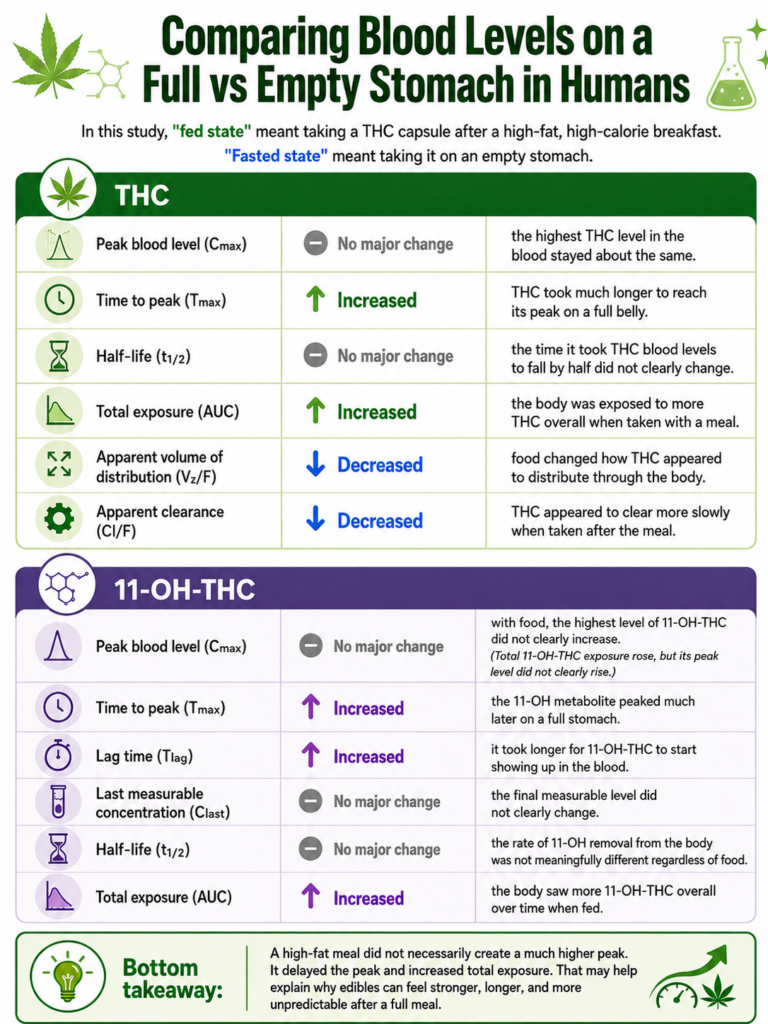
Graphical study summary (based on table 7) created with ChatGPT 5.5; Lunn S, Diaz P, O’Hearn S, et al. Human Pharmacokinetic Parameters of Orally Administered Δ9-Tetrahydrocannabinol Capsules Are Altered by Fed Versus Fasted Conditions and Sex Differences. Cannabis Cannabinoid Res. 2019;4(4):255-264. Published 2019 Dec 6. doi:10.1089/can.2019.0037
This AUC change is the part I think matters most in real life. A full, fatty meal may not make your edible “hit” right away. In this study, it actually made the peak come later. But it may also increase the total amount of THC and 11-OH-THC your body is exposed to. That combination is one reason edibles can be so unpredictable.
Someone takes an edible after dinner, waits a while, does not feel much, and decides it must not be working. Then they take more. A few hours later, both doses are coming online, and now they are way higher than intended.
That does not mean food is always bad. Some people may even prefer the slower, longer shape of that experience. For some medical consumers, that drawn-out effect may be part of the goal. But it does mean timing matters more than a lot of people realize. More experienced users sometimes think in terms of redosing after 2–3 hours, but this paper is a good reminder that when THC is taken on a full stomach, the real peak may still be well ahead of you. For an experienced user, this may not be a problem. For someone newer to THC, it can become very intense very quickly.
The paper also tried to look at sex differences. Females had a significantly higher THC Cmax than males in the 5 mg fasted condition, but that pattern was not the main finding of the paper. The authors also point to previous research suggesting females may sometimes reach higher peak levels of THC and 11-OH-THC after oral use, but this study does not settle that question. So the honest takeaway is that sex-related differences may be real, and they could matter for some people, but the food effect was much clearer than the sex effect here.
This study does not answer every edible question. Not even close. It does not tell us exactly how your favorite gummy behaves. It does not erase all the other reasons edibles vary from person to person, including dose, metabolism, tolerance, product formulation, digestive differences, and what else someone has eaten that day.
But it does add to the evidence that taking oral THC with a high-fat meal can meaningfully change blood levels. Specifically, it may delay the peak, increase total exposure, and create a more drawn-out experience.
For better or worse, that is not just a pharmacokinetic curiosity. It is a practical explanation for why the same dose of THC can feel mild one day and much more intense the next.


Sign up for bi-weekly updates, packed full of cannabis education, recipes, and tips. Your inbox will love it.