



 Merch
Merch Medical card



Weed butter, also called cannabis butter or cannabutter, is regular butter infused with cannabinoids extracted from cannabis. To make cannabutter, decarboxylate the cannabis, combine it with butter, and infuse it at a low temperature before straining and chilling the finished butter.
This cannabis butter recipe explains how to make weed butter in a Crockpot and on the stovetop. It also covers the weed-to-butter ratio, infusion time and temperature, straining, storage, and how to estimate potency before using cannabutter in brownies or other edibles.


For this batch, use ¼ ounce, or 7 grams, of decarboxylated cannabis with 8 tablespoons of butter. Homemade cannabutter can be stronger than expected, so estimate the potency of the whole batch and begin with a small serving.
Before you begin: use and store cannabis butter safely
Use cannabis only where it is legal and only if you meet the minimum legal age. Edibles can take two hours or longer to produce noticeable effects, so do not take another serving simply because the first has not worked immediately.
Clearly label the finished butter as cannabis-infused and keep it separate from ordinary food. Store it where children, pets, and other people cannot consume it accidentally.
Save this recipe to your inbox
Recipe: How to make weed butter
Making cannabutter is straightforward when you control three variables: the cannabis-to-butter ratio, the infusion temperature, and the cooking time.
Ingredients
- 0.25 oz
of ground cannabis, decarboxylated
- 8 Tbsp
- 7 grams
of ground cannabis, decarboxylated
- 8 Tbsp
Method 1 — Crockpot or slow cooker
(For this method, in addition to the ingredients listed above, you will need a crock pot.)
Method
- Fill the Crockpot about halfway with water and heat it to 160-190°F (70-88°C). Check the water temperature with a kitchen thermometer rather than relying only on the appliance setting.
- Cut the butter into cubes and place it in one or more heat-safe mason jars. Add the decarboxylated cannabis, stir to distribute it, and fit the lids according to the jar and appliance manufacturer’s instructions. Use a tight fitting lid for better control of the smaell during the cook.
- Place the jars in the heated water and cover the Crockpot. Infuse for 2-4hours, keeping the water within the target temperature range. Carefully stir the contents after the first hour and then once per hour.
- After the desired time is passed, carefully remove the hot jars from the crockpot and allow them to cool for about 10 minutes.
- Line a fine-mesh strainer with cheesecloth and strain the warm mixture into a heat-safe container. Let it drain naturally instead of squeezing the cloth aggressively.
- Cover and refrigerate the cannabutter until firm. Transfer it to a clearly labeled airtight container and record the preparation date and estimated potency.
The finished cannabis-infused butter can replace part of the ordinary butter in brownies, cookies, sauces, and other recipes.
Chef Jordan’s tips
- Add fresh vanilla or lemon zest for a sweet infusion, or thyme, mint, or rosemary for a savory one. Use aromatics sparingly so they do not overpower the finished recipe.
- Some multicookers can decarboxylate or infuse cannabis, but pressure settings, jar requirements, jar requirements, and cooking times vary. Follow an appliance-specific recipe and the manufacturer’s safety instructions. In mu experience, an instant pot achieves the same results but you have to cut the cook time by 30-60 minutes.
- Unsalted butter is the most versatile choice. Salted butter, clarified butter, ghee, and some plant-based butters may also work, although their flavor, fat content, and water content vary.
Method 2 — Stovetop Saucepan:
(For this method, in addition to the ingredients listed above, you will need 1 cup of water and a saucepan.)
Add 1 cup of water and 1 cup of butter to a saucepan and heat on low until the butter melts. Stir in the decarboxylated cannabis. Keep the mixture at approximately 160-180°F (70-82°C) for 2-3 hours, stirring every 20-30 minutes. Keep it below a rolling boil and add a small amount of water if too much evaporates.
After 2-3 hours, remove the saucepan from the heat and let it cool for about 10 minutes. Strain the warm liquid through a cheesecloth-lined fine-mesh strainer into a heat-safe container.
Refrigerate the strained mixture until the butter hardens. If water was used, lift off the solid butter, discard the separated water, and dry the underside of the butter before storing it.
How long should cannabis butter cook?
Infuse cannabutter for 2-3 hours in a saucepan or 2-4 hours in a Crockpot. Longer cooking does not automatically produce stronger butter. Maintaining a low, stable temperature is more important than extending the infusion indefinitely.
What temperature should cannabutter be infused at?
Keep a stovetop infusion at approximately 160-180°F (70-82°C). A Crockpot water bath can be maintained at approximately 160-190°F (70-88°C). Check the liquid or water bath with a thermometer because appliance settings do not show the actual infusion
temperature.
How to strain weed butter without making it bitter
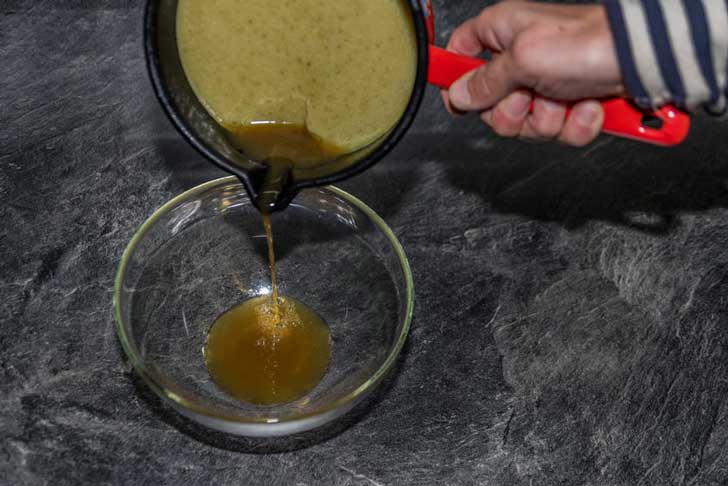
Strain cannabutter while it is warm and liquid. Line a fine-mesh strainer with cheesecloth, pour slowly, and let gravity drain the butter. Avoid wringing the cloth because this can force fine plant particles and stronger herbal flavors into the finished butter.
What is the best weed-to-butter ratio?
This recipe uses ¼ ounce, or 7 grams, of cannabis with 8 tablespoons, or ½ cup, of butter. For a less concentrated batch that may be easier to portion, use the same amount of cannabis with 1 cup of butter. The best ratio depends on the labeled cannabinoid percentage and the intended serving size, not only the weight of the cannabis.
How to estimate cannabutter potency
Homemade cannabutter cannot be dosed precisely without laboratory testing. The potency of the starting material may differ from the label, and cannabinoids can be lost during decarboxylation, infusion, straining, and storage. A calculation should therefore be described as an estimate or theoretical maximum.
Cannabis weight in grams × 1,000 × THC percentage as a decimal × 0.87 decarboxylation factor × 0.80 infusion-efficiency factor = estimated total milligrams of THC
Then divide the estimated total THC by the number of tablespoons, teaspoons or servings produced.
For example, 7 grams of cannabis labeled as 14% THC would contain an estimated 682 mg of THC after decarboxylation and infusion losses:
7 × 1,000 × 0.14 × 0.87 × 0.80 = 682.08 mg THC
If the finished batch contains 8 tablespoons of cannabutter, the estimated potency would be:
682.08 ÷ 8 = approximately 85.3 mg THC per tablespoon
Because one tablespoon contains three teaspoons:
85.3 ÷ 3 = approximately 28.4 mg THC per teaspoon
Can you make weed butter with shake, trim, or leaves?
Yes. Shake and resinous trim can be decarboxylated and infused using the same basic process. Their potency may be lower or less predictable than labeled flower, so weigh the material rather than measuring it by tablespoons and do not assume that it has the
same THC percentage as flower.
Large fan leaves generally contain fewer cannabinoids than flower or resinous trim and may produce a weaker infusion.
Can you make cannabis butter with kief or hash?
Kief and hash can be infused into butter, but they should not be substituted gram-for-gram for cannabis flower. They may contain much higher cannabinoid concentrations and can require different ratios, decarboxylation conditions, and filtration methods.
Common mistakes when making cannabutter
Skipping decarboxylation: Infusing cannabis without properly decarboxylating it can produce a less predictable result because much of its cannabinoid content may remain in acidic form.
Assuming every cannabis material has the same potency: Shake, trim, flower, kief, hash, and already-vaped cannabis can produce very different results. Use labeled potency data when available and treat unknown material as unpredictable.
Letting the butter boil or scorch: Keep the heat low, monitor the temperature with a thermometer, and stir periodically. A rolling boil makes temperature control more difficult and can cause scorching.
Grinding the cannabis too finely: Powdered cannabis is harder to strain and can make the finished butter gritty, green, and bitter. Break the decarboxylated flower into coarse, evenly sized pieces.
Squeezing the cheesecloth: Wringing the plant material can force sediment and bitter flavors into the butter. Let it drain naturally.
Treating a potency estimate as an exact dose: Homemade infusion efficiency varies. Clearly identify calculated values as estimates.
Taking another serving too soon: Begin with a small serving and wait for the effects before considering more. Edibles can take two hours or longer to produce noticeable effects.
Why is butter used for cannabis infusions?
Cannabinoids such as THC and CBD associate readily with fats. Butter therefore provides a practical culinary carrier for cannabinoids extracted from cannabis. The final composition and flavor depend on the starting material, temperature, infusion time, and filtration method.
What is decarboxylation, and why does cannabutter need it?
Decarboxylation is the process of heating cannabis before infusion to convert acidic cannabinoids into their neutral forms.
For example, decarboxylation converts THCA into THC and CBDA into CBD. Completing this stage separately makes the activation and butter-infusion stages easier to control.
A common home method is to spread cannabis evenly on a baking sheet and heat it at approximately 220-245°F (105-120°C) for about 30-45 minutes. Oven temperatures fluctuate, so monitor the cannabis carefully and avoid burning it.
➤ Step-by-step instructions: How to decarboxylate cannabis
What can you make with weed butter?
Cannabutter can replace part of the ordinary butter in brownies, cookies, cakes, frosting, pasta sauces, mashed potatoes, and flavored compound butter.
Do not automatically replace all the butter in a recipe. Using part cannabutter and part ordinary butter gives you more control over the estimated amount in each serving

Frequently asked questions
Yes. Water is not required for cannabinoid extraction, but it can help regulate the temperature and reduce the risk of scorching in a stovetop recipe. It separates from the butter after refrigeration.
Cannabis can be heated in butter for an extended period, but the process is less controlled. Decarboxylating first separates cannabinoid activation from infusion and makes both stages easier to manage.
Using more cannabis relative to the amount of butter can increase the theoretical concentration. Calculate the potential potency before changing the ratio, and consider diluting the finished cannabutter with ordinary butter in the final recipe.
Yes. Freeze it in small, measured, clearly labeled portions. Keep it secured away from children, pets, and anyone who may mistake it for ordinary butter.
THC butter usually means cannabutter made with THC-dominant cannabis. Cannabutter is the broader term and may contain THC, CBD, or other cannabinoids depending on the starting material.


Sign up for bi-weekly updates, packed full of cannabis education, recipes, and tips. Your inbox will love it.
Rate this Recipe













Hi! I’ll like to make 1 stick of cannabutter by using your cannabutter recipe, but I’m having trouble measuring the exact amount of grounded cannabis flower to make the cannabutter, how much grounded cannabis flower in 0.25 oz would be in tablespoons? I’ll be using this recipe to make 1 batch of brownies by using your brownie recipe, thanks!
Is there a recipe for marijuana balm?
Do I grill or bake the dope in the oven? Also why would you add water to your butter + dope in the saucepan? I’ve never added water to my cookies why would I add it to my butter? No way will I ever add water!
He isn’t actually telling you to add water to your butter, he is using the crock pot and mason jars as a double boiler method so it doesn’t burn.
Wow, this guide is super helpful! I’ve always wanted to try making cannabutter but was unsure about the process. The step-by-step instructions make it seem really easy. Can’t wait to give it a shot!