

 Merch
Merch Medical card
The Season of Thin Veils
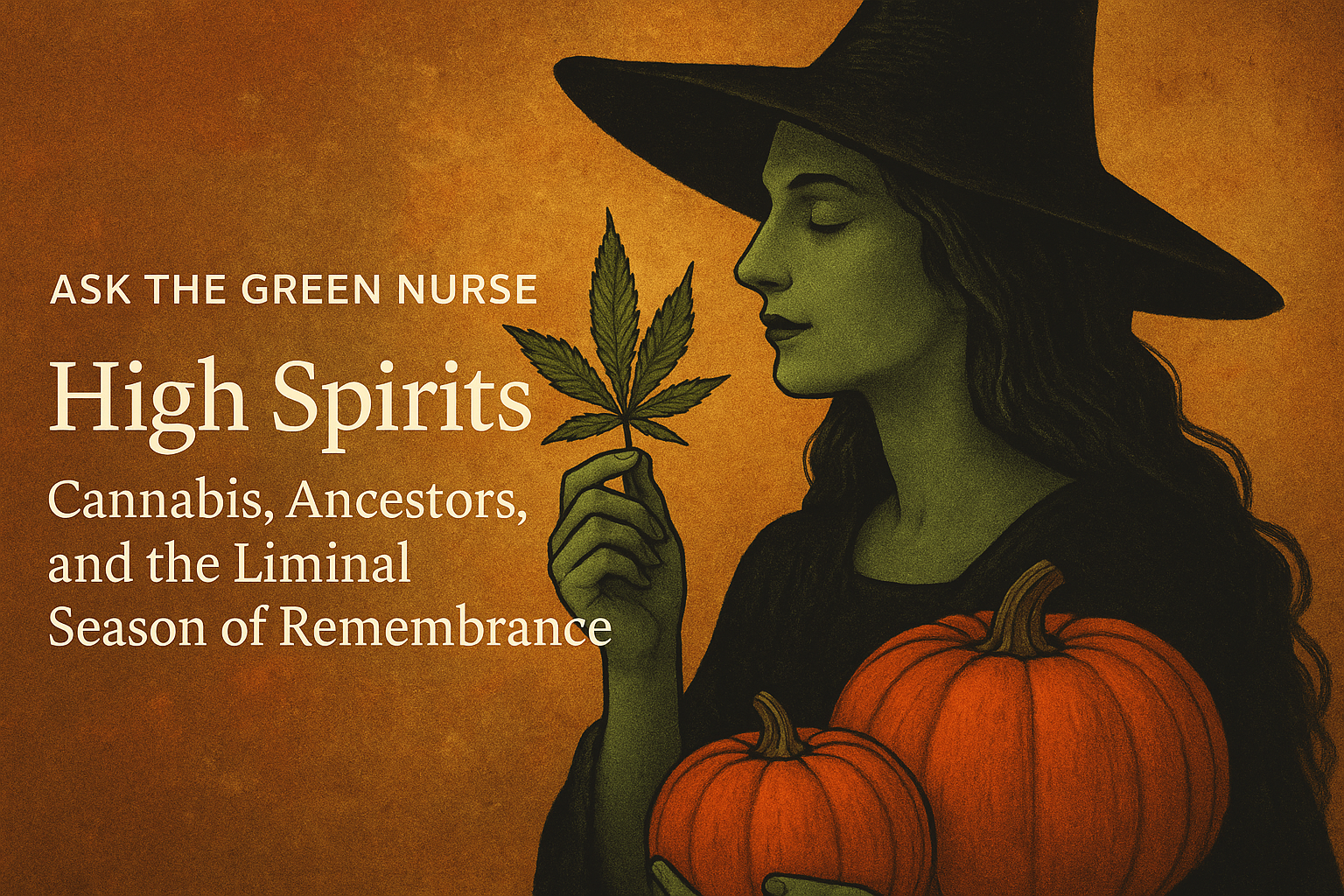
Every autumn, as the days shorten and the harvest moon glows, the veil between worlds thins. Across cultures and centuries, humans have marked this turning of the wheel — from Samhain and All Hallows’ Eve to Día de los Muertos — with rituals of remembrance, fire, and sacred plants. These traditions invite us to pause, to honor the dead, and to prepare for the inward journey of winter.
As a nurse rooted in both science and spirituality, I’ve often wondered: was cannabis ever part of these rituals of remembrance? Was the “holy herb” invited to these sacred feasts for the ancestors?

Harvest and History
Halloween’s roots lie in the Celtic festival of Samhain, a time when fires burned to guide spirits home and protect the living from mischief. While records show that herbs like mugwort, juniper, and yarrow were burned for purification and divination, cannabis does not appear in the traditional pharmacopeia of early Gaelic celebrations (Royal Queen Seeds, 2022).
As Christianity spread, Samhain evolved into All Saints’ and All Souls’ Days, preserving the theme of honoring the dead while reframing it through a Christian lens (Library of Congress, 2021). Likewise, in Mexico and other parts of Latin America, the Day of the Dead (Día de los Muertos) fused Indigenous Mesoamerican rituals of ancestor veneration with Catholic observances. Families built altars, offered marigolds, candles, and food — symbolic gifts bridging the living and the departed (History.com Editors, 2023).
Traditional offerings included copal resin, tobacco, cacao, and maize — sacred plants representing life and death — but not cannabis. Its ritual use was documented in other regions, such as India’s bhang ceremonies or African spiritual healing traditions (Rätsch, 2005). The absence of cannabis from Samhain or Día de los Muertos doesn’t negate its sacredness; rather, it reminds us that each land and lineage has its own plant allies.
Myth-Busting the Haunted Herb
Modern myths sometimes claim that cannabis was once used in witchcraft or even that Halloween candy is secretly laced with THC. Both claims collapse under scrutiny. The “THC-laced candy” panic reemerges annually, yet law enforcement and toxicology reports reveal no confirmed cases of strangers distributing edibles to children (High Times, 2021).
Similarly, while medieval “witches” were depicted mixing psychoactive herbs — including belladonna and mandrake — cannabis was rarely among them. In truth, much of the association between cannabis and sorcery reflects centuries of fear and misunderstanding of both female healers and forbidden plants.
The modern reimagining of cannabis as a “Halloween herb” speaks less to history and more to harvest timing — many cultivators trim and cure their plants in October, coinciding with the season of shadow and reflection (Royal Queen Seeds, 2022). Symbolically, this alignment feels fitting: a plant of balance and transformation, ripening just as the Earth turns inward.
Cannabis as a Plant Ally of Transition
Every plant has its medicine beyond chemistry. Cannabis, with her green heart and grounding aroma, teaches us to release, remember, and realign. As autumn strips the trees bare, cannabis helps us let go — of tension, grief, or anxiety — and settle into stillness.
From a spiritual nursing perspective, this aligns with the Spirituality-First Clinical Model, a framework that emphasizes the importance of addressing meaning, emotion, and human connection as foundational elements of care. Rather than focusing solely on biology or physical symptoms, this model encourages a holistic approach that considers the spiritual and emotional well-being of patients as central to their overall health and healing process. Cannabis can encourage reflection on mortality and continuity, easing fear by fostering a sense of presence. It acts as an ally in transition, not by altering consciousness, but by expanding it, offering the compassion needed to face what we naturally resist.
In palliative and hospice care, low-dose cannabinoids can gently support sleep, manage pain, and promote emotional peace, helping patients find acceptance at the threshold between life and death. Here, the ancient traditions of All Saints’ Day and Día de los Muertos find a modern resonance, reminding us that death is not an end but a transformation of energy. Check out the blog post and Webinar Campaign – Clinical Conversations on Cannabinoids for End of Life Care | The Cannigma
Other Sacred Herbs in the Season of Spirits
While cannabis may not have graced the original altars of these autumn rituals, other sacred herbs carried the same intention. Copal resin smoke in Mexico was said to nourish ancestral spirits. Sage and juniper were burned across Europe and North America to cleanse energy and ward off harm. Mugwort, the dreamer’s herb, was steeped in tea or stuffed in pillows to enhance vision and lucid dreaming (Rätsch, 2005).
In this council of plants, cannabis now takes her rightful seat — not as an intruder, but as a bridge between worlds. Like copal, she clears the heaviness of grief. Like sage, she centers the heart. Like mugwort, she opens the inner eye.

The Nurse’s Lens: Healing in the Liminal
For holistic nurses, the liminal season is a mirror for practice: tending both to the living body and to the unseen forces that shape it. Whether lighting a candle for a patient who has passed or encouraging a loved one to journal their memories, we engage in modern rituals of remembrance.
Mindful cannabis use can become part of this healing — not as recreation, but as reverence. A few deep breaths of a calming strain, shared in gratitude, can open the heart and quiet the nervous system. The goal is not intoxication but intention — to honor the cyclical nature of life and to reconnect with the sacredness of being. Check out the cannabis blog on Mindfulness & Cannabis Consumption for Health, Wellness, and Healing | The Cannigma
As the veil thins, we remember that the endocannabinoid system itself is a bridge — a network of receptors maintaining homeostasis, balance, and connection between mind, body, and spirit. In this way, science affirms what the ancients intuited: we are woven into the same web of life that all sacred herbs inhabit.
High Spirits
As leaves fall and ancestors whisper,
May your breath be a bridge between worlds.
May the smoke of your sacred herbs rise like prayer,
softening sorrow into remembrance,
fear into forgiveness,
and endings into beginnings.
When the night feels long,
light your candle, lift your heart,
and let your spirit burn bright.
For those who came before you
still dance in the medicine of your breath.
Blessed be the living.
Blessed be the gone.
Blessed be the green that grows between.
Happy Halloween!
With you on the journey,
Ask The Green Nurse with Sherri Mack BSN, RN & Elisabeth Mack MBA, BSN, RN
Ask The Green Nurse content on the Cannigma is brought to you by Holistic Caring & The Green Nurse and Bloom Hemp CBD.
- Holistic Caring & The Green Nurse – Comprehensive plant medicine education for patients and healthcare providers, including CEUs for nurses, along with expert coaching and private consulting services.
- Join The Green Nurses in their Free Holistic Caring Network to access continuous learning and meaningful connections with other patients and providers who are learning about the most misunderstood plant in the world. Enjoy a monthly plant medicine support group, an introduction to cannabis program, and the ABCs of CBD program—all at no cost.
- Bloom Hemp CBD – Experience Doctor and Nurse-formulated Organic Hemp CBD, crafted with Ayurvedic inspiration and designed to target specific symptoms. Benefit from free access to a nurse hotline at 970-404- HOPE (4773) and personalized care plans, thoughtfully provided by expert cannabis nurses. Shop today, use promo code GREENURSE for 10% savings and free shipping.
References
- High Times. (2021, October 27). The myth of cannabis-infused Halloween candy debunked.
- History.com Editors. (2023, October 31). Day of the Dead (Día de los Muertos).
- Library of Congress. (2021, October 28). The origins of Halloween traditions
- Royal Queen Seeds. (2022, October 25). Halloween, cannabis, history, strains, and films.
- Rätsch, C. (2005). The encyclopedia of psychoactive plants: Ethnopharmacology and its applications. Park Street Press.


Sign up for bi-weekly updates, packed full of cannabis education, recipes, and tips. Your inbox will love it.