

 Merch
Merch Medical card
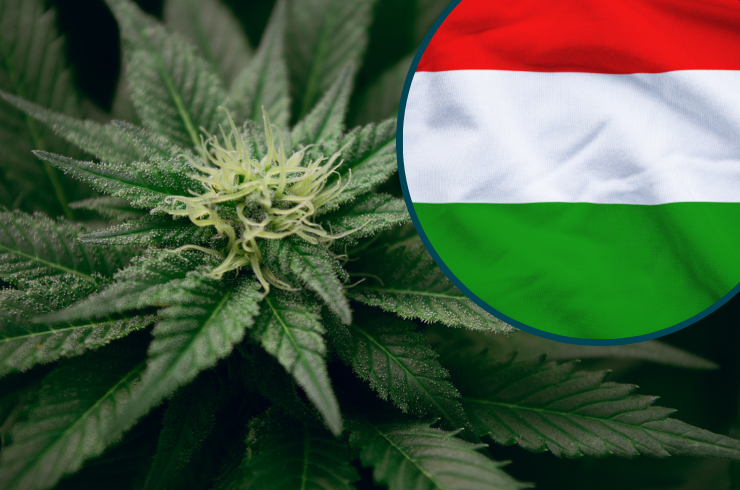
Quick answer: no, and Hungary is one of the strictest countries in the European Union on this. Consuming cannabis is itself a criminal offence carrying up to 2 years in prison, possession above the small-quantity threshold carries 2 to 8 years, and Hungary tightened the whole framework in June 2025 rather than loosening it. There is no decriminalised amount and no recreational tolerance.
What Hungarian law says about cannabis
Cannabis offences sit in Act C of 2012, the Criminal Code, at sections 176 to 184, with the quantity definitions that drive every sentence at section 461. The scheduling itself is done by Government Decree 66/2012 (IV. 2.), which lists cannabis, cannabis resin and cannabis extracts and tinctures in its first narcotics schedule.

Two changes since 2024 matter more than anything else on this page.
Act XIX of 2025 came into force on 15 June 2025 and raised the sentencing ranges, folded new psychoactive substances into the ordinary drug offences, and narrowed the treatment-instead-of-prosecution route. In the same year Hungary amended its Fundamental Law to prohibit the production, use, distribution and promotion of narcotics, putting the prohibition at constitutional level.
Then the politics moved the other way. Hungary changed government at the April 2026 election, and the incoming party campaigned on a new evidence-based drug strategy and on restoring harm-reduction funding. As of September 2026 nothing has been repealed or amended, so the 2025 framework described below is the law in force. This is the part of the article most likely to date.
The quantity thresholds are measured in THC, not plant weight
Hungary is unusual in fixing its thresholds by pure active substance rather than by street weight, and getting this wrong is the single most common error in English-language coverage.
Section 461 sets three lines for cannabis. Small quantity is 6 grams of total THC, meaning the free and acid-form THC content combined, or alternatively no more than five cannabis plants. Substantial quantity is 120 grams of total THC, twenty times the small-quantity ceiling. Particularly substantial quantity is 1,200 grams of total THC.
Because the figure is a THC mass rather than a bud weight, the amount of herbal cannabis that crosses the line depends entirely on potency, which is established by laboratory analysis in each case. As a rough illustration only, at around 10 percent potency, 6 grams of total THC corresponds to somewhere near 60 grams of herbal material. That conversion is not in the statute and no defendant should rely on it.
Penalties for cannabis possession in Hungary
Consuming cannabis, or possessing a small quantity for your own use, carries up to 2 years in prison under section 178(6). That is the tier most visitors and most casual users fall into, and the key point is that it is a criminal offence with a custodial maximum rather than a fine or an administrative penalty.
Above the small-quantity line, section 178(1) carries 2 to 8 years, raised from 1 to 5 years by the 2025 Act. Section 178(2) covers commercial-scale possession, offences committed within a criminal association, and offences committed by an official, at 5 to 10 years, raised from 2 to 8. Substantial quantity carries 5 to 15 years and particularly substantial quantity carries 5 to 20.
Supply and trafficking sit in section 176. Offering, handing over, putting into circulation or trading carries 2 to 8 years at the basic level, 5 to 10 where a criminal association or an official is involved, and 5 to 20 years or life imprisonment for a substantial quantity.
Offences involving anyone under 18, or committed on the premises of an educational, child-welfare or cultural institution, escalate under sections 177 and 179, starting at 5 to 10 years for trafficking. The 2025 Act also raised consuming drugs on school premises to 1 to 5 years and directed courts to impose custody absent exceptional circumstances.
Penalties at a glance
| Conduct | Quantity | Prison range | Criminal Code section |
|---|---|---|---|
| Consumption, or possession for own use | Small quantity (up to 6 g total THC) | Up to 2 years | 178(6) |
| Possession | Above small quantity | 2 to 8 years | 178(1) |
| Possession, commercial scale or criminal association | Above small quantity | 5 to 10 years | 178(2) |
| Possession | Substantial (120 g total THC) | 5 to 15 years | 178 |
| Possession | Particularly substantial (1,200 g total THC) | 5 to 20 years | 178 |
| Supply, circulation or trading | Basic | 2 to 8 years | 176(1) |
| Supply, circulation or trading | Substantial | 5 to 20 years or life | 176(3) |
| Trafficking involving a minor or on institution premises | Basic | 5 to 10 years | 177(1) |
Ranges reflect Act XIX of 2025, in force from 15 June 2025. Conduct before that date is judged under the earlier, lower ranges, which is why older sources still show 1 to 5 years for basic possession.
The treatment route, and how 2025 narrowed it
Hungary’s diversion scheme, known as elterelés, lets a personal-use offender avoid punishment by completing treatment instead. Section 180 now attaches four conditions, and the fourth is new.
The offence must involve a small quantity for the person’s own use. The defendant must admit the offence. They must complete at least six months of continuous treatment, counselling or a preventive service before the first-instance judgment. And, since 2025, they must disclose the circumstances of the offence and enable the identification of the person who sold them the drugs.
That last condition changes the character of the scheme, because it turns a treatment option into a cooperation requirement. Giving false information about a supplier can itself be prosecuted as false accusation.
Two bars apply. Diversion is unavailable if the person was granted it, or was convicted of a drug offence, within the preceding two years. And the 2025 Act added a lifetime cap of two uses, so a third occasion means permanent exclusion.
The scheme carries real volume: criminal-justice referrals into drug treatment for cannabis users exceed 60 percent in Hungary, among the highest rates in Europe.
How Hungary compares with the rest of the EU
Hungary is an outlier in the direction most people do not expect. The European Union Drugs Agency lists Hungary among the small group of countries where consuming cannabis is itself an offence carrying a possible prison sentence, alongside Cyprus, France, Finland, Greece, Norway, Sweden and Türkiye.
In the agency’s record of national legal changes since 2000, Hungary appears under the heading of increasing the prison penalty, while most of the continent moved the other way.
You can read the agency’s comparison of how EU countries respond to cannabis use and supply for the full picture.
Hungary has also been on the wrong end of an EU ruling in this area. In Case C-271/23, decided by the Grand Chamber of the Court of Justice on 27 January 2026, the Court held that Hungary infringed EU law by voting against the Council’s common position at the UN Commission on Narcotic Drugs on rescheduling cannabis.
The judgment concerns the duty of sincere cooperation and the unity of EU external representation, and it does not require Hungary to create a medical cannabis programme.
Is medical cannabis available in Hungary?
There is no national medical cannabis programme. Access runs through ordinary pharmaceutical channels and is narrow in practice.
Epidyolex, a cannabidiol medicine indicated for Lennox-Gastaut syndrome and Dravet syndrome from the age of two, is the cannabis-derived medicine registered in Hungary’s official medicines database.
Other products, including the 1:1 THC and CBD extract nabiximols and the synthetics dronabinol and nabilone, are described as obtainable through individual patient application rather than as routinely marketed products, and the registration position for those is not clearly documented in public sources.
Products sourced within the European Economic Area require a regulatory statement, products from outside it require an authorisation, and reimbursement is a separate individual application.
A Medián poll conducted for the Hungarian Medical Cannabis Association in July 2026 found 81 percent support for allowing physicians to prescribe cannabis for specific conditions, which is a long way ahead of where the law sits.
Is CBD legal in Hungary?
The honest answer separates the law from what you will see in shops.
Hungary’s medicines and food-supplement regulator, OGYÉI, states that CBD-containing food supplements may not lawfully be marketed in Hungary.
Its reasoning is that cannabis extracts and other derivatives containing cannabinoids, CBD included, are novel foods, that novel foods may only be used as food once authorised under Regulation (EU) 2015/2283, and that no EU-level authorisation has been granted for CBD in any case. That position was last updated in February 2025.
A visible CBD retail sector nonetheless operates in Hungary. The safer commercial category is cosmetics and other non-ingestible products; ingestible CBD supplements are sold despite the regulator’s stated position. So do not read “CBD is sold here” as “CBD is legal here”, and do not assume a product on a Hungarian shelf has been assessed by anyone.
On hemp, the two Hungarian authorities do not currently agree with each other. The EU agricultural THC limit for industrial hemp rose from 0.2 percent to 0.3 percent under Regulation (EU) 2021/2115, applicable from 1 January 2023, and the Hungarian trade licensing side uses 0.3 percent.
Food-side guidance from the food chain safety authority, dated January 2024, still refers to 0.2 percent for varieties used to make food. Maximum THC levels in hemp foods themselves are set by Commission Regulation (EU) 2023/915.
What about designer drugs and synthetic cannabinoids?
Hungary ran a separate new psychoactive substance regime for over a decade, under which possessing a small amount of a synthetic cannabinoid was a misdemeanour punishable by detention rather than imprisonment.
Act XIX of 2025 abolished that separate category on 15 June 2025 and created a new offence at section 184. Offering or handing over such a substance to assist another person’s harmful consumption carries up to 2 years, up to 3 years where more than ten people gain access, and 1 to 5 years for putting it into circulation or trading. The practical effect is that possession of a designer drug now carries prison exposure where it previously did not.
What travellers need to know
The UK Foreign, Commonwealth and Development Office states in its Hungary travel advice that illegal drugs including cannabis carry severe penalties, and that a traveller should expect a long jail sentence and heavy fines for possessing, using or smuggling them, including when transiting through the airport.
Budapest’s reputation as a party destination does not extend to cannabis. There is no coffeeshop model, no tolerated possession amount, and no distinction between a private flat, a ruin bar and the street. Bringing cannabis in from a country where it is legal is an import offence, and a prescription or medical card issued abroad provides no defence.
The US State Department’s Hungary page says almost nothing about drug offences and was last updated in 2023, so it predates the 2025 law entirely. Do not treat its silence as reassurance.
Is Hungary’s cannabis law likely to change?
Possibly, but nothing has changed yet. The 2025 package moved firmly toward zero tolerance, including a constitutional prohibition, and harm-reduction funding was withdrawn from two major programmes.
The government that took office in April 2026 has promised a new national drug strategy built on evidence and international practice, a national drug coordinator, and restored harm-reduction funding, but its published programme does not commit to decriminalisation or to legalising medical cannabis.
Anyone relying on this page for a decision should check the current position rather than assume the September 2026 snapshot still holds.
Last reviewed: September 17, 2026.


Sign up for bi-weekly updates, packed full of cannabis education, recipes, and tips. Your inbox will love it.